Showing posts with label Durham Cathedral. Show all posts

Tuesday, 22 March 2016

The Flag of County Durham


County Durham’s official flag is something of an oddity, having been designed and adopted in the very recent past – 2013, in fact – being the last of England’s northern counties to take up the flag-waving mantle. As you can see, it shows the outline of St.Cuthbert’s Cross counter-changed horizontally between the county colours of blue and yellow (or gold, if you prefer!).

Prior to this, the ‘unofficial’ flag looked like this…


…being the county council’s official effort, and in use from the 1970s county boundaries reshuffle. However, in the summer of 2013, campaigner Andy Strangeway launched an online competition for a new design – and the winner was the splendid effort at the top of this piece. It was put together by twins Katie and Holly Moffatt and their father James from Chilton, near Ferryhill, who beat off the competition by public vote. And by the end of November 2013 the flag was flying proudly over Durham Cathedral.


Tuesday, 1 March 2016

Greenwell’s Glory (NZ168464)


William Greenwell was born in 1820 at Greenwell Ford, a little to the south of Lanchester, Co.Durham. He lived a long and full life, dying a few weeks short of his 98th birthday in January 1918 - and, being born into a life of some privilege, he was accorded many opportunities during his extended stay on the planet. However, Greenwell is best remembered for something remarkably trivial.

He was educated at Durham School and at University College, Durham, before shunning a career as a barrister in London, deciding instead to return to the North-East and a life in the church. In 1854, he was appointed canon of Durham Cathedral (a post which he held until his death), and dabbled, too, in the life of the university. He was also an archaeologist, and became a leading light in the various clubs and societies of the region which were dedicated to the pastime. He excavated sites at Danes Graves, Yorkshire, and Grimes Graves, Norfolk, and amassed an immense collection of artefacts, which is now held by the British Museum.

His greatest claim to fame, though, is the delightfully named ‘Greenwell’s Glory’ - a trout fly for flyfishing, created for him by famed fly-dresser, Jimmy Wright of the Borders. It came about following a day of disappointment for Greenwell whilst fishing in the Tweed; whereupon a visit to Mr Wright brought about a new creation based on the canon’s observations of the day. The new design was fashioned thus:

The wings, inside of a blackbird wing; body, red and black hackle; tied with yellow silk.

Simple, yet highly effective, as, the very next day, Greenwell returned to Mr Wright’s abode with his creel and pockets bulging with trout - and the name ‘Greenwell’s Glory’ was born in the ensuing celebration. This is all thought to have happened in the mid 1850s, but the new fly soon caught on, and, indeed, is still with us today.  


Tuesday, 14 April 2015

Flodden: What Happened to James IV? (NT890371)


Most history fans will know all about the Battle of Flodden of 1513. Big English victory, crushing Scottish defeat … and the Scots lost their king on the battlefield, too, of course. However, in the blood, mayhem and general confusion that followed, no one seems to quite know for sure what became of James IV’s body. If he died at all, that is.

Accounts of almost all aspects of the story vary – sometimes wildly. What is known for sure is that his army lost heavily and his reign very much ended on that fateful autumn day a little over 500 years ago. He was almost certainly slain in the field, possibly after having stripped himself of his royal regalia to prove he could and would fight as fiercely as any ordinary soldier. He was known to be fearless in the fray and such a demise would not have been out of character.

In the mess that was left after the battle it could not have been easy identifying the ex-monarch, especially if he’d removed his royal garb. Lord Dacre was supposed to have found the corpse, probably on the small hill on Branxton Ridge overlooking Branxton Church. Dacre then had the body taken to Berwick, where it was identified by two Scottish courtiers, before it was embalmed and taken, firstly, to Newcastle, then York, and afterwards onto London (Sheen Priory in Surrey). In the meantime, what was left of the late king’s royal gear found its way to Durham Cathedral.

There was a suggestion that the body be forwarded to English King Henry VIII, but this seemingly never happened. Then rumours of James’ survival began circulating. In Lucan-esque fashion, he was spotted abroad on several occasions, having slipped away at the height of the battle and thence into exile in far off lands; and there were counter-rumours that he had escaped the battlefield and was caught and killed during the Scottish retreat. Some claimed that the recovered corpse was actually that of a ‘Lord Bonhard’.

The ‘official’ body lay at Sheen Priory, London, for a good while. Henry VIII wanted to show some respect and have it interred at St.Paul’s, but as James had been excommunicated this proved difficult and it seems to have just kicked around the priory for years. After the Reformation it seems to have gone missing, though another story has it that the head was secreted away and hurriedly buried in the charnel pit of St.Michael’s Wood Street in the centre of London. This church has long since disappeared, and the site is now occupied by a pub (ironically called The Red Herring). Sheen Priory, on the other hand, is now a golf course.

But check out these, too:-
  • Two Scottish castles claim (without any evidence) to be the true burial site of James;
  • In the 18th century, the owners of Hume Castle in Berwickshire found a skeleton with an identifying chain belt down its well – which then either went missing or was whisked off for burial at Holyrood Abbey;
  • … Roxburgh Castle has made a similar claim;
  • And then there was the story of the ‘royal body’ pulled out of the ground somewhere near Kelso;
  • Oh, and there is also a tall tale involving spectral riders snatching the body from the battlefield to prevent the English getting their hands on it.

Deary me.

At last, though, a fact: if King James IV of Scotland was slain in the mud and blood of Flodden Field, which is very likely, then he achieved the notable feat of being the last Scottish – or, indeed, British – monarch to be killed in battle. But can we have such a fact without a body?


Tuesday, 2 December 2014

Eglingham’s Wandering Cleric (NU106195)


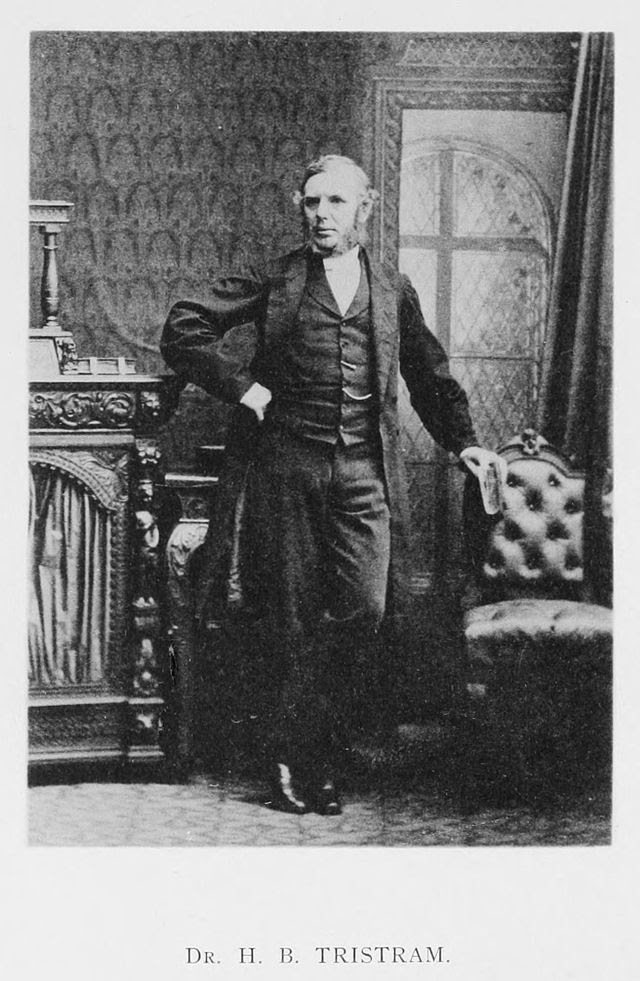
Canon Henry Baker Tristram was an English clergyman, naturalist, Biblical scholar and traveller. Somewhat controversially for his time, he was an early convert to Darwinism, and spent many years attempting to reconcile the theory with his religious beliefs.

Tristram was born at Eglingham vicarage in 1822 – the eldest son of the vicar – and studied at Oxford. He was ordained a priest in 1846, but his fragile health (TB included) forced him to live abroad. He travelled widely, including a stint as secretary to the governor of Bermuda from 1847 to 1849, where an interest in birds blossomed – but on returning to UK shores found the winters too much for him. Several expeditions to Algeria followed, including exploration of the Saraha desert and yet more ornithological adventures – and wrote a book entitled The Great Sahara. He first visited Palestine in 1858, returning there several times, where he expanded his collection of birds and identified possible Bible sites. Amidst all of this he became canon of Durham Cathedral in 1873, though his travels continued, including the Middle East and also Japan where his daughter spent decades working as a leading light at the Church Missionary Society’s School for Girls.

His infamous link with Darwinism began in the late 1850s when he was seduced by the writings of the great evolutionist. Looking at his own collections of birds, he became convinced of the validity of the new-fangled theory, and penned articles in support of the same.

Tristram, who was a Fellow of the Royal Society, wrote books, papers and articles of all his various adventures, concerned mainly with naturalism and the topography of the Bible lands. His sizeable collections of birds and eggs ended up in Liverpool’s World Museum and the Natural History Museum, London. And as any ornithologist will know, a number of birds are now named after him … as well as a breed of gerbil!

He died in 1906 and has a window dedicated to his memory in the north aisle of Eglingham Church.


Would you like to write a post for the 'North-East History Tour'? 
Click here for further details.
Don't be shy!

Tuesday, 5 March 2013

Sacriston’s Roots (NZ235480)


Sounds very ‘religious’ doesn’t it? And you’ll not be surprised to learn that, yes, the town of Sacriston does, indeed, owe its founding to something relating to the cathedral down the road.

On a little spur overlooking the woods to the north-west of the settlement was the site of a now long-gone medieval manor house. Hugh Pudsey, perhaps Durham’s most famous Bishop, gave the area to the sacristan of Durham Cathedral monastery in the 12th century, and eventually a manor house was built there in the 13th century. In case you’re wondering, a sacristan was a senior monk responsible for sacred relics, together with the general day-to-day running of a religious house (these guys were more recently known as sextons).

During its early history, the plot of land was farmed by monks and the revenue raised was used to provide the sacristan with, effectively, his living. Over the years, bits and pieces were sold off, and on the Dissolution what was left was passed back to Durham Cathedral.

On maps thereafter it was shown as Sacristan Heugh, but with the coming of large-scale mining in the 19th century – and the development of the nearby town – the area took on the name of Sacriston. However, locals did (and still do) refer to the town affectionately as Segerston or ‘Segga’, a term derived from the old spelling/pronunciation of the root word for ‘sacristan’.

Though a few stones from the old manor house survived within Heugh House, a farm building later constructed on the site, the complex was demolished shortly after World War II owing to subsidence caused by the surrounding mineworks. 


Tuesday, 25 December 2012

St.Cuthbert’s Final Resting Place? (NZ273421)


Via Wikipedia (public domain)

As we all know, the mortal remains of St.Cuthbert lie in Durham Cathedral, right? Well, probably. The picture above tells us the official story, but a legend has persisted for centuries that the great saint’s bones actually rest elsewhere – and that the secret location has been passed down to a select handful of clerics still living today.

The history of St.Cuthbert’s remains and all the various relics that went with him is a lengthy one. To cut this very long story down to a manageable size, after his death in 687AD he was shipped from pillar to post for several centuries until he was finally laid to permanent rest within the walls of the newly-built cathedral around the turn of the twelfth century.

He has been disturbed at least thrice since. Once in 1541 when the Dissolution targeted the city, then in 1827 and 1899. The sum of the various investigations carried out at these times seemed to confirm the traditional story of the various shenanigans surrounding his post-mortem adventures – yet a curious rumour persists. Was, in fact, the body switched at some point, and the real remains hidden elsewhere?

The story goes that when Henry VIII and his chief minister Thomas Cromwell turned their eyes to Durham Cathedral in the dying days of the Dissolution, the monks panicked and substituted Cuthbert’s remains for some other nobody – probably a quick body switch during an overnight stay in the desecration process. As it happens, the ‘sacred remains’ – whether genuine or not – were reburied in due course, and remain where you will find them today, duly marked by a dirty big tombstone. Another version has Cuthbert’s genuine remains being desecrated, re-buried, then subsequently switched during 1542-58 for fear the royal commissioners should return for another poke at the same.

If the true remains were ever secreted away – to another spot in the cathedral, or elsewhere – nobody knows. Well, apart from a long, thin line of trusted clerics through which the secret has passed these past 450 years. 

Tuesday, 18 December 2012

Durham Cathedral & the Dunbar Martyrs (NZ273421)


For all its Norman grandeur, Durham Cathedral was the scene of one of the most heinous war crimes in British history. The story of the Dunbar Martyrs is hardly a secret as such, but over the years the harsh facts of the sorry episode have certainly been conveniently and repeatedly skirted around.

It all began with Oliver Cromwell’s defeat of the Scots at the Battle of Dunbar in September 1650. Thereafter, the English leader, not in the best of moods, proceeded to ransack much of Scotland whilst sending 5,000 prisoners on a forced march south, where they were bolted up in Durham Cathedral. During their journey they covered 120 miles in eight days with no food or water (except whatever they could quickly scavenge) – and almost half the soldiers died en route, with the remaining 3,000 being crammed into the cavernous cathedral building and castle on 11th September.

And there they were kept until 31st October, with virtually no food or water – or indeed heating. They helped themselves to much of the woodwork within in an attempt to keep warm, but illness and disease quickly gripped the prisoners, with dozens dying every day. One of the few items to escape the captives’ makeshift fires was a clock embossed with a Scottish thistle – an item which survives to this day.

Of the 3,000 who began the ordeal, around 1,400 survived – and most of these were promptly sold as slave labour to the new English colonies in the Americas. About 500 were pressed into lengthy military service overseas.

During maintenance work in the 1940s a mass grave was allegedly discovered to the north of the cathedral, it being (it was assumed) the Scottish burial pit. Subsequent investigations have, however, failed to confirm the theory.

A campaign is currently underway to erect a memorial to the victims of this appalling episode.


Tuesday, 28 August 2012

Cosin-work at Sedgefield (NZ357288)


John Cosin was one of Durham’s most famous prince-bishops. He ‘ruled’ for a little over eleven years from December 1660, and was generally held in good regard for his work both within and without the Church – including promoting the interests of schools and charities.

Arguably his most famous legacy, however, is the unique style of church woodwork he championed – an elaborate and intricate cross between Gothic and Jacobean. Little of this remains today, however – the font cover in Durham Cathedral being the best example. Further fine examples of Cosin-work were tragically destroyed by fire at Brancepeth in 1998, leaving those remaining at St.Edmund’s Church, Sedgefield, as perhaps the best we have left of this distinctive style of craftsmanship.

Surprisingly, there are no good images to be had of St.Edmund’s beautiful interior décor on the Internet*. You’ll just have to go and see it for yourself, I guess.


* If you know of any let me know.

Friday, 8 July 2011

Warden Law & the Legend of the Dun Cow (NZ370507)


The story of the Dun Cow, as depicted in the above eighteenth-century panel on the north facade of Durham Cathedral, supposedly explains how the remains of St.Cuthbert came to find their way to the city of Durham – an event which led, in turn, of course, to the construction of the mighty Durham Cathedral.


Legend has it that in around 995AD the monks of Lindisfarne, whilst traversing the North-East with the saint’s holy remains in tow, came to rest upon Warden Law, a prominence a little to the north-east of Houghton-le-Spring.  On attempting to resume their journey they couldn’t move the cart upon which the coffin was being carried, and resorted to prayer in order seek divine guidance.  Bishop Aldhun (or the monk Eadmer – accounts vary) then had a vision in which he was told to take St.Cuthbert’s remains to ‘Dunholme’, but nobody knew where that was.

The story goes that the monks then overheard a passing milkmaid asking a local woman if she had seen her wandering dun (greyish-brown) cow.  The local was heard to have said that she thought she’d seen it walking towards Dunholme, whereupon the maid made her way westward.  The monks then quickly gathered themselves and returned to the coffin with the intention of following the young girl, whereupon they found that, miraculously, the cart now moved freely.

And so the party moved happily down the road, bound for the saint’s final resting place.

Mind you, it’s not the only hill that claims the rights to the story!