Showing posts with label Houghton-le-Spring. Show all posts

Tuesday, 16 April 2013

William Shanks and Pi (NZ345499)


Pi, the ratio of a circle’s circumference to its diameter, is perhaps the most famous of our mathematical constants. It has fascinated many of the brightest sparks in the history of mankind, often dominating the thoughts of far too many for far too long. It even has a film of its own.

Just as strangely fascinating as pi itself are the odd-ball folk who have, over the years, dedicated large chunks their lives to its calculation. Yes, mathematicians are strange creatures, and the extraordinary William Shanks was no exception.

In the long chronology of the computation of pi, that of Mr Shanks’ is right up there with the best of them. And he was a North-East boy: born in Corsenside, Northumberland, but who lived out the final several decades of his life in Houghton-le-Spring. He settled there in 1847 after marrying his wife, Jane, in London the previous year.

He owned and ran (and lived in) a private boarding school in Nesham Place, an activity which afforded him plenty of time to indulge his passion for sums and such like. He was soon publishing works on mathematics, and began working on the expansion of pi at an early stage. Beginning in the early 1850s, he pushed the computation of the famous constant out beyond 500 decimal places – then 600, then finally (in 1873, after a bit of a rest) claimed a whopping 707. During his ‘gap years’ of 1850s-early 1870s he worked on many other mathematical problems, including the calculation of e and Euler’s Constant y to more decimal places than ever before. He also published a table of prime numbers up to 60,000, found the natural logarithms of 2, 3, 5 and 10 to 137 places, and a whole host of other bits and bobs.

Shanks’ work on pi remained unchallenged (and unbettered) until 1946, when his landmark 707 decimal places was found to contain an error at the 528th place when a certain D.F.Ferguson tapped the problem into his desk calculator. Shanks’, on the other hand, had no such luxury of course. He would work for hours, manually, on his little problems most mornings, then check for errors in the afternoons – taking him a good twenty years get as far as we can get in a split second today.

William Shanks died, aged 70, in 1882, and was buried in nearby Houghton Hillside Cemetery


Would you like to write a post for the 'North-East History Tour'? 
Click here for further details.
Don't be shy!


Tuesday, 9 April 2013

The Gilpin Thorn (NZ340498)


Until twenty years or so ago there stood in the corner of the garden of the Rectory at Houghton-le-Spring an ancient, natural relic known as the Gilpin Thorn. It was an ugly, gnarled affair – a hawthorn tree most probably – which was said to have been planted by Bernard Gilpin, the great ‘Apostle of the North’. Gilpin was the local rector at St.Michael and All Angels Church during 1558-1583, and was much famed for his piety and benevolence. The tree is said to have sprung from a cutting taken from the famous Glastonbury Thorn.

This local landmark was, until the mid-20th century at least, maintained with some care – or so it seems. Reports from Victorian times have the tree being braced with collars, then when, under its own weight, it split in two, its tired limbs were propped up by timber supports. Pictures from the 1950s show the tree struggling manfully on, but by the 1980s it appears to have entered a phase of terminal decline. Local vandals helped it on its way to an undignified death and removal around 1990.

But the story does not end there. A local man, Peter Tate, had had the foresight to take seeds from the old tree before it expired, and saw to it that two new seedlings were born. One of these was planted in the grounds of the Rectory … though it appears that both specimens have now disappeared, whereabouts unknown.

What a strange old story.

Note: Almost all of the information upon which this article is based was taken from the Houghton-le-Spring Heritage Society website – an excellent little article, within which you will also find some nice pictures. It’d be great if anyone could shed further light on the mystery of the missing saplings – do comment below if you can help.


Tuesday, 2 April 2013

Apostle of the North (NZ342498)


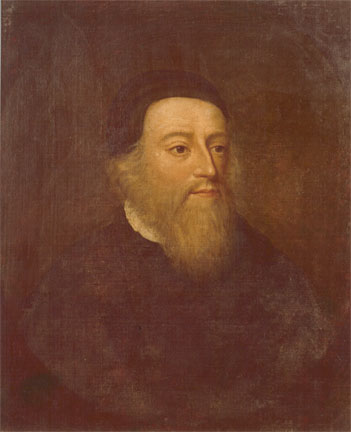
Bernard Gilpin is one of the true icons of the history of the North-East of England. He was born in Kentmere in what we now call the Lake District, but earned his fame as Rector of Houghton-le-Spring during 1558-1583.

Gilpin was born into a well-to-do family in 1517 and attended Oxford University where he became a student of religious doctrine. Prior to his appointment at Houghton-le-Spring he moved through various posts and places during what was, of course, a period of turbulent religious and political manoeuvrings (the 1540s and 1550s). He even spent a spell on the continent during the reign of Queen Mary.

On his return to England, he was invested with the archdeaconry of Durham by his mother’s uncle, the Bishop of Durham (in 1556). Gilpin, though, had a history of attacking clerical vices – a stance which brought him many enemies. Twice at around this time he was openly attacked by his peers, but defended by the Bishop. It was then that he was handed the attractive post at Houghton-le-Spring. Attacked again thereafter he was summoned to London, but was saved possible martyrdom by breaking his leg en route and the convenient death of Queen Mary. So off he toddled back to the North-East.

During his long tenure as Rector at Houghton-le-Spring he gained a reputation for great benevolence. The richness of his office enabled him to entertain the great and the good – as well as the poor. Every Sunday from Michaelmas to Easter he kept open house, providing dinner for all who came. He also aided in the education of the local children, including the building of a grammar school in the town.

Gilpin, though, gained his reputation proper by travelling widely across the region, from Northumberland to Yorkshire and from Cumberland to Teesdale, where he spread the word of God and became the so-called ‘Apostle of the North’. He was offered other posts, including the See of Carlisle, but preferred to carry on the work he had started from his base in Houghton-le-Spring.

In 1583, aged 66, and much weakened by a recent accident with an ox in Durham Market, Bernard Gilpin died, and was laid to rest in his church. His tomb still adorns the interior.


Would you like to write a post for the 'North-East History Tour'? 
Click here for further details.
Don't be shy!


Friday, 8 July 2011

Warden Law & the Legend of the Dun Cow (NZ370507)


The story of the Dun Cow, as depicted in the above eighteenth-century panel on the north facade of Durham Cathedral, supposedly explains how the remains of St.Cuthbert came to find their way to the city of Durham – an event which led, in turn, of course, to the construction of the mighty Durham Cathedral.


Legend has it that in around 995AD the monks of Lindisfarne, whilst traversing the North-East with the saint’s holy remains in tow, came to rest upon Warden Law, a prominence a little to the north-east of Houghton-le-Spring.  On attempting to resume their journey they couldn’t move the cart upon which the coffin was being carried, and resorted to prayer in order seek divine guidance.  Bishop Aldhun (or the monk Eadmer – accounts vary) then had a vision in which he was told to take St.Cuthbert’s remains to ‘Dunholme’, but nobody knew where that was.

The story goes that the monks then overheard a passing milkmaid asking a local woman if she had seen her wandering dun (greyish-brown) cow.  The local was heard to have said that she thought she’d seen it walking towards Dunholme, whereupon the maid made her way westward.  The monks then quickly gathered themselves and returned to the coffin with the intention of following the young girl, whereupon they found that, miraculously, the cart now moved freely.

And so the party moved happily down the road, bound for the saint’s final resting place.

Mind you, it’s not the only hill that claims the rights to the story!