Showing posts with label Royal Society. Show all posts

Tuesday, 26 July 2016

The Extraordinary William Emerson (NZ308102)


One of the North-East’s greatest eccentrics, William Emerson, was born in Hurworth-on-Tees in 1701. He was also a brilliant mathematician, and can perhaps rightly be called a savant – a genius in his chosen field, yet a social misfit extraordinaire. His writings reached far and wide, including into the substantial mind and intellect of the great Thomas Jefferson.

He followed his schoolmaster father, Dudley, into the sphere of mathematics. As a young student, though, his offensive manner caused him to be sent to Newcastle and York during the course of his studies. In 1730 he returned to Hurworth to take over the running of his late father’s school, but his social shortcomings led to the institution’s closure in 1733. He resolved instead to live off his inherited estate near Eastgate, Weardale.

In 1735 he managed to get himself married to Elizabeth Johnson, the daughter of the Hurworth rector. However, his father-in-law, disapproving of his unkempt and uncouth new relative, refused to pay the £500 dowry, so Emerson piled all his wife’s clothes into a barrow and wheeled it round to the parsonage, saying he refused “to be beholden to such a fellow for a single rag”. In time, though, Emerson would make all those who thought him a wastrel eat their words.

Though he never really broke any new ground in his work, it was the interpretation and application of existing theories which would prove to be his greatest strength. His first work, The Doctrine of Fluxions [i.e. calculus], wasn’t published until he was into his 40s, but it became an instant bestseller. And, thereafter, as the man himself modestly pointed out, “I stepped forth, like a giant in all his might.”

And so he did. More than a dozen more critically acclaimed mathematical treatises followed on subjects such as trigonometry, astronomy, mechanics, navigation, algebra, optics, motion, music and more – all of them known for their error-free nature. The Principles of Mechanics (1754) really made his name, and was used by students into the Victorian era. Practical experimentation lay at the centre of his mathematical world, as he set his students to work splashing about in the Tees for his work on navigation, for example. He was, of course, consulted widely, yet when the Royal Society wished to make him a Fellow he refused, saying: “When a man becomes eminent, he has to pay quarterly for it. This is the way ingenuity is rewarded in England. Damn them and their FRS too.”

This outspokenness marked Emerson’s character all his life. He was often vulgar, ungrateful, bad-tempered, and had an infamously scruffy dress code. He would only tie the top and bottom buttons of his waistcoat, and wear his shirt back-to-front to keep himself warm. Then there were his bulging shin-covers, worn to stop his legs burning in front of the fire – to say nothing of his ill-fitting wigs! He walked everywhere, drank to excess and would stand fishing in the Tees for hours in the hope that the water would wash out his gout.

This mad genius died in 1782, aged 81, and was buried in Hurworth churchyard. And so finally, in the words of his epitaph, death, “as it happeneth to the fool, so it happeneth even to me.”


Tuesday, 24 November 2015

The Venerable Charles Thorp (NZ151648)


When you hear the name Charles Thorp muttered in and around the parish of Ryton these days, it is almost always in connection with the secondary school bearing his name in the heart of the town. The recent renaming process of the said institution has helped, if nothing else, to bring back to the fore the distant memory of a man who led a quite extraordinary life – and most certainly put Ryton well and truly on the map in his day.

Born in Gateshead in 1783, Thorp led an admittedly privileged life. The son of an archdeacon of Northumberland, he was educated at Newcastle’s Royal Grammar School and Durham School, before spells at both Cambridge and Oxford Universities. He became a tutor at Oxford, before eventually returning to Tyneside as Rector of Ryton in 1807. He remained in the post for 55 years.

Rising through the ranks, he was also created Canon (1829), and then Archdeacon (1831) at Durham, before becoming the very first Warden of the University of Durham in 1832 – playing a major role in the founding of the institution. He also became, simultaneously, the university’s first Master. As if that wasn’t enough, he became a Fellow of the Royal Society in 1839.

Even that, in fact, wasn’t anywhere near enough. He was years ahead of his time in many other spheres of society. Firstly, of course, there was education, where he set up a free school in Ryton; then there was the establishment in the town of the country’s very first ‘penny bank’ (enabling those on low incomes to save and borrow at reasonable rates); and he was also a bit of an environmentalist, planting trees in the churchyard as well as purchasing the Farne Islands and appointing a wildlife warden.

Just as notable were his activities on the international front where he campaigned tirelessly against slavery. In Sierra Leone his efforts were especially worthy – to the extent of setting up a university for freed slaves in the country’s capital, Freetown.

He was married twice, and died in Durham in 1862. He was buried in Ryton churchyard.


Tuesday, 2 December 2014

Eglingham’s Wandering Cleric (NU106195)


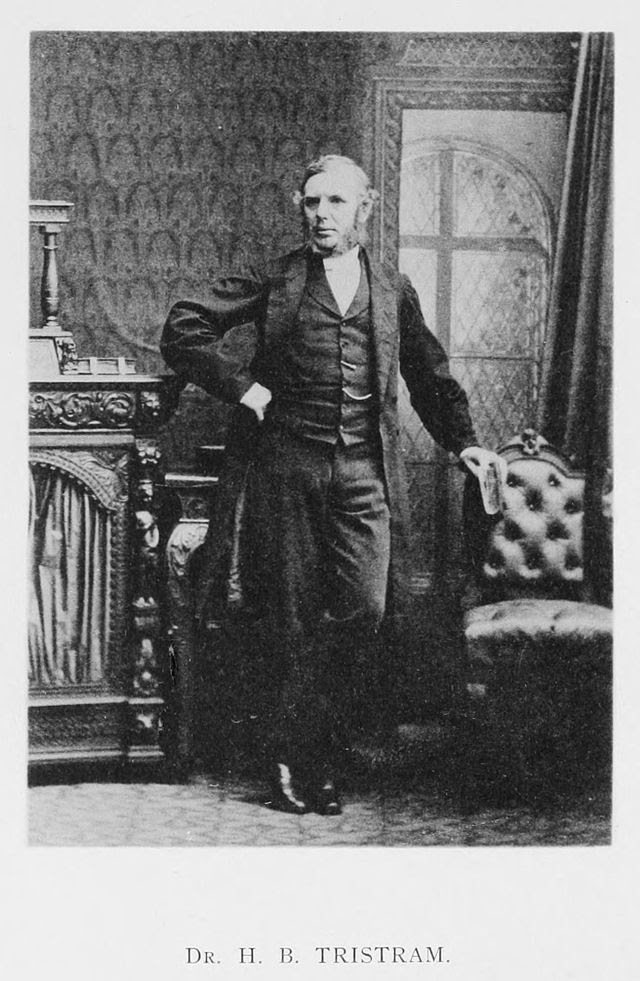
Canon Henry Baker Tristram was an English clergyman, naturalist, Biblical scholar and traveller. Somewhat controversially for his time, he was an early convert to Darwinism, and spent many years attempting to reconcile the theory with his religious beliefs.

Tristram was born at Eglingham vicarage in 1822 – the eldest son of the vicar – and studied at Oxford. He was ordained a priest in 1846, but his fragile health (TB included) forced him to live abroad. He travelled widely, including a stint as secretary to the governor of Bermuda from 1847 to 1849, where an interest in birds blossomed – but on returning to UK shores found the winters too much for him. Several expeditions to Algeria followed, including exploration of the Saraha desert and yet more ornithological adventures – and wrote a book entitled The Great Sahara. He first visited Palestine in 1858, returning there several times, where he expanded his collection of birds and identified possible Bible sites. Amidst all of this he became canon of Durham Cathedral in 1873, though his travels continued, including the Middle East and also Japan where his daughter spent decades working as a leading light at the Church Missionary Society’s School for Girls.

His infamous link with Darwinism began in the late 1850s when he was seduced by the writings of the great evolutionist. Looking at his own collections of birds, he became convinced of the validity of the new-fangled theory, and penned articles in support of the same.

Tristram, who was a Fellow of the Royal Society, wrote books, papers and articles of all his various adventures, concerned mainly with naturalism and the topography of the Bible lands. His sizeable collections of birds and eggs ended up in Liverpool’s World Museum and the Natural History Museum, London. And as any ornithologist will know, a number of birds are now named after him … as well as a breed of gerbil!

He died in 1906 and has a window dedicated to his memory in the north aisle of Eglingham Church.


Would you like to write a post for the 'North-East History Tour'? 
Click here for further details.
Don't be shy!

Tuesday, 24 July 2012

Sir Anthony Carlisle (NZ364227)


Old Stillington – the original village, not the nineteenth century creation which jumps out at you from the map of today – lies a mile to the south-west of the modern affair on a quiet back road. Its simple layout has scarcely changed since the time of Anthony Carlisle’s birth there way back in 1768 – a young lad who would move onto the world stage during the course of his lifetime, yet is barely remembered today.

The son of Thomas Carlisle by his first wife (identity unknown), Anthony was apprenticed to medical practitioners in York and Durham, before completing his studies in London and being appointed Surgeon at Westminster Hospital in 1793. He remained there until his death in 1840.

But in the days when men of science dabbled in several disciplines, Carlisle’s mind often wandered. During one such ‘distraction’ he made the not insignificant discovery of the process of electrolysis with chemist William Nicholson in 1800 – this being the process of driving chemical reactions by passing electricity through a liquid substance*. In this case, it was the passing of a current through water, thus decomposing it into its basic elements of oxygen and hydrogen. Just as importantly (for him, at least) he got himself married in 1800, too, to one Martha Symmons.

Though he never followed through with his newly-created science, many others did to stunning effect. Carlisle’s contribution was acknowledged, though, when he was elected a Fellow of the Royal Society in 1804 (and served as Professor of Anatomy of the Society during 1808-1824).

From 1815 he began a long association with the (Royal) College of Surgeons, serving as president in 1828 and 1839. He lectured widely and prominently**, and was appointed Surgeon Extraordinary to King George IV(1820–1830) – and must therefore have known, quite intimately, the sufferings of the monarch’s father, ‘Mad’ King George III, prior to the man’s death in 1820.

Carlisle was knighted in 1821, and died, after a long and successful career, in London in 1840. He is buried in Kensal Green Cemetery.


* & ** Because of his association with electrochemistry, Carlisle has been labelled ‘The Real Mr Frankenstein’ (see here, and see also here – and scroll down), and his lectures were often especially graphic – and very popular! He may even be the author behind the 1797 gothic horror classic The Horrors of Oakendale Abbey, which tells of resurrected men and body-snatchers.


Monday, 30 August 2010

The Smithsonian Museum and its North-East Connection

I can’t possibly leave the subject of the life of the 1st Duke of Northumberland without claiming a neat little piece of glory for the region. For the very famous Smithsonian Institute and all its related museums and educational centres throughout the US owes its very foundation to the man – or rather, the man’s son.

Or, to put it more brusquely, the Duke’s illegitimate son.

The mighty American organisation was founded thanks to a bequest left in the will of one James Smithson, a British mineralogist and chemist, who died in 1829. Smithson had been a wise investor, amassing a huge fortune which he left, initially, to his nephew. However, it was stipulated in the will that if the beneficiary were to die without issue (which he thoughtfully did, in 1835), then the money should be passed “to the United States of America, to found at Washington, an establishment for the increase and diffusion of knowledge among men.”

James Smithson – or Jacques Louis Macie, as he was originally known – was born in Paris in 1764 to one Elizabeth Hungerford Macie (nee Keate), following an affair with a prominent English landowner, Sir Hugh Smithson. Sir Hugh, who would eventually become the 1st Duke of Northumberland, was, at this time, married to Elizabeth Seymour, a Percy heiress, and had actually changed his name to Hugh Percy in order to inhert the earldom of Northumberland on his father-in-law’s death in 1750 – and would eventually be created 1st Duke in 1766.

Heavily influenced by his mother’s side of the family (his father, Hugh, never acknowledged him), James took the scientific route, being elected to the Royal Society in 1787 aged only 22. In 1802, a little after his mother’s death, he changed his name from Macie to Smithson. He died in Genoa in 1829, his remains being later moved and reburied in Washington D.C. at the Smithsonian Institution Building.

Astonishingly, James Smithson had never set foot in the US during his lifetime, and the reason for his bequest is unknown.