Showing posts with label John Dobson. Show all posts

Tuesday, 23 June 2015

Biddlestone Chapel (NT955084)


© Copyright Les Hull and licensed for reuse 

The odd little edifice that is Biddlestone Hall Chapel has quite a history, but, remote though it is, it is bang in line with modern day life – for it is a remarkable example of architectural recycling. It is, of course, not at all odd that a building should be restructured and reused over the years, but Biddlestone Chapel is a nice little survival all the same, with an interesting story to tell.

First mention of a building on the site is in the shape of a fortified manor, or tower, house in 1415. By the 1600s, the original building was incorporated into a larger manor house, which was itself upgraded to a Georgian house c.1800 by the ruling Selby family. In about 1820, the Catholic-leaning family employed the famous architect John Dobson to convert the upper floors of one corner of their mansion into a chapel. The building we see today was the result of Dobson’s dabblings: a lofty and rather odd-shaped affair, with the bottom bits looking a good deal different than the upper extremities. Then, in typical Victorian fashion, the chapel’s interior was much altered in 1862.

The Selbys had been around this remote spot since, it is said, the early 14th century, but finally vacated Biddlestone in 1914, leaving their large Georgian house with chapel annex to fall into disrepair. During World War II the chapel’s tunnel-vaulted basement was converted into an air-raid shelter – though for what reason it is difficult to deduce. By the 1950s the ruin had become too much for anyone to take on as a viable concern and the decision was taken to demolish the main building – leaving the chapel standing tall and proud in its rather lonely situate. Shame, really, for the old mansion was believed to have been the model for Sir Walter Scott’s Osbaldistone Hall in Rob Roy.

Despite its periodic restructuring, the tower-cum-chapel-cum-air-raid shelter retains much of its medieval masonry and other ancient features, and is rather beautiful from whatever angle the visitor casts their gaze. The building has recently been re-vamped and still holds the occasional service and event.

Tuesday, 5 August 2014

Meg O’ Meldon (NZ108855)


The sleepy hamlet of Meldon in the Wansbeck valley a few miles west of Morpeth was once the home of one of the county’s most infamous ghosts, namely, Meg O’ Meldon. As with most such shadowy figures, the story of Meg is based loosely on fact – in this case that of a misery old woman (and suspected witch) by the name of Margaret Selby. There are spectral appearances, tales of misfortune (and good fortune), as well as, of course, hidden treasure...

Margaret was the daughter of William Selby of Newcastle, who was a well-known money lender. She married Sir William Fenwick of nearby Wallington, and brought with her to the arrangement the estate of Meldon. This all happened a long time ago – in and around the late 17th century – and well before the construction of the current John Dobson-inspired effort known today as Meldon Park. Anyway, the only facts that seem to have trickled down to us from these distant days concern the infamy of Meg’s great meanness and avarice. Any income which came her way was greedily hoarded, being stashed away in any number of places across the parish. She was understandably disliked and therefore (of course) branded a witch; and when she and her husband passed into history, stories persisted of caches buried in almost every corner of the district.

Such was her reputation, though, that the locals claimed that her spirit continued to guard over her riches after her demise, wandering from pillar to post, triggering tales of ghostly apparitions aplenty in its wake. Meg’s spirit would travel hither and thither by way of a subterraneous coach road, and she would often be seen on Meldon Bridge in the shape of a little dog – or, indeed, ‘in a thousand forms, lights and colours, flickering over the Wansbeck, or under a fine row of beeches by the river.’ She would sometimes present herself as a mysterious, beautiful woman; or sit in a stone coffin at the site of Newminster Abbey (water from this trough was used to treat warts and other ailments).

Most famously, the ghost of Meg would sit guard over a well near Meldon Tower, where she was thought to have hidden a bull’s hide full of gold. She once enticed a local man to attempt its retrieval at the dead of night, but at the point of success he shouted in triumph, thus breaking the spell and causing the treasure to be dropped and lost forever.

Understandably, any discovery of value in the neighbourhood has been attributed to the legend of Meg. Once, when the ceiling of Meldon schoolhouse gave way, a stash of gold coins issued forth from the attic, sending the pupils into a ‘rich scramble’ for their unexpected windfall. Every time a stash is thus revealed and put to some good, so the spirit of Meg rests ever more soundly. And, though Meldon Well still hides its bag of riches, the ghost of Margaret Selby has long since disappeared from the banks of the Wansbeck.


Tuesday, 18 February 2014

Benwell Towers (NZ211645)


Benwell Towers, c.1900 
(source: Newcastle City Library)

Readers of a certain age will know Benwell Towers without knowing it, as it were. For between 1989 and 2006 the rambling, crenellated creation in Newcastle’s West End was the ‘youth club’ from the BBC children’s TV series Byker Grove. As fascinating as that simple fact may be, the overall history of the mansion (and the site) is, in fact, far more interesting…

In the long centuries before the village of Benwell was swallowed up by the sprawl of Newcastle, the previous incarnations of the grand old building existed as far back as at least the early thirteenth century. This original erection was a three-storied tower house belonging to the priors of Tynemouth – and with it there persists all sorts of rumours of underground catholic escape tunnels! All goes quiet until the 16th / 17th centuries, when a manorial wing was added to the tower. Further additions and alterations followed in the eighteenth century – the work of the building’s long-term owners, the Shafto family – during which time the great landscape gardener, Lancelot ‘Capability’ Brown, may have had some input.

In the 1770s the manor house changed ownership and ultimately suffered for it, falling into general decay by the early 1800s. Colliery owner, Thomas Crawhall, took possession at this time and decided on a complete re-build, turning to famous local architect, John Dobson, for inspiration – all of which led to the pleasing asymmetrical hotch-potch of masonry we see today.

In 1882, the site entered another phase of use, being gifted to the religious authorities as the bishop’s residence for the newly-created Diocese of Newcastle. In fitting with its new-found status, a fancy new Perpendicular-style chapel was added.

During WWII, the building was pressed into service as a fire station, and, thereafter, as a training centre for the National Coal Board from 1947 (including the HQ of the mine rescue service). For many years the edifice was known widely as The Mitre public house and restaurant – the writer spending his underage drinking years there in the early 1980s.

Only after its closure as a pub did it achieve national fame via Byker Grove, Ant and Dec et al. After a decade and a half’s use at the hands of the Beeb it once more fell into disuse, its owners finally putting it up for sale a few years ago. It has recently found yet another new owner and seems destined to reopen as an Islamic school and community centre in the near future. All in keeping with its eclectic history, I suppose.


Friday, 23 December 2011

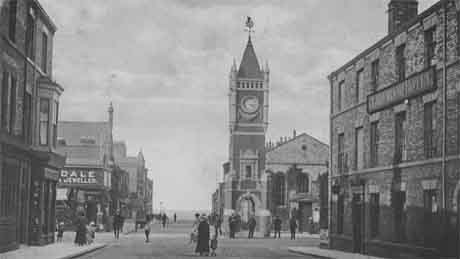
Redcar Town Clock (NZ602252)


Question: When does a Coronation Clock become a Memorial Clock?  Answer: When it’s in Redcar!  Let me explain…

During the future Edward VII’s long wait for the British throne, he became something of a regular at the bracing North-East seaside resorts that are Redcar and Coatham.  So much so, in fact, that when he was due to finally succeed his mother as monarch in 1901, the local dignitaries thought it a splendid idea to raise a special Clock Tower in his honour – so they set about collecting donations.

Redcar and Coatham had recently amalgamated into a single authority, so it was thought appropriate to site the new structure on the old boundary between the two.  Anyway, he can’t have been that popular, as the appeal fell largely on deaf ears.  £300 was raised – some of it by selling ‘penny bricks’ – but it wasn’t considered enough to complete the project, so the venture was shelved.

Come 1910 and the death of the said monarch, they had another whip-round and this time the locals dug a little deeper.  The erection was finally built and dedicated as a, erm, Memorial Clock Tower.  Architect: William Duncan.  Builder: John Dobson.  Clock by Robert Richardson.  Unveiled 29th January 1913.

Better late than never.

The image is from a 1914 postcard.  The clock was restored to working order in 2006.

My History

Tuesday, 9 August 2011

Hawthorn Tower(s) (NZ438461)


This lovely little effort didn’t exist pre-1820, nor is there any trace of it left today, amazingly enough.  Hawthorn Tower(s), originally known as Hawthorn Cottage, was built in 1821 to the designs of John Dobson for Major George Anderson, a Newcastle big-wig.  Anderson died in 1831, but his wife lived on in the property until her death in the 1850s – afterwhich the Pembertons assumed ownership and renamed it Hawthorn Tower(s).  At some point in the 1850s, it was also extended in size.

In 1910, the Pembertons vacated the premsies, and let the pile out, firstly, to colliery agent Malcolm Dillon, then to another colliery official, Mr Henegan.  In 1930, the Boys' Brigade rented the Tower for weekend camps, and it was used during World War II by the military and the Home Guard.  The Pembertons then returned briefly, before selling up in c.1949 to a South Shields man.  Several more sales followed, during which period the house fell into a state of decay.  Vandals help send the structure to its ultimate demolition in 1969 after a man was killed by a partial collapse.  Today nothing remains.  It’s as if the old place never existed.

There’s a fair bit more to be found on Hawthorn Tower(s) – including the nineteenth century census returns for the structure – at the DurhamRecordsOnline website, here.


Tuesday, 22 February 2011

The Collingwood Monument (NZ372691)

 
© Copyright Ken Brown and licensed for reuse under this Creative Commons Licence.


This Monument

was erected in 1845 by public subscription to the memory of

Admiral Lord Collingwood,

who in the “Royal Sovereign” on the 21st October 1805, led the British Fleet into action at Trafalgar and sustained the Sea Fight for upwards of an hour before the other ships were within gun shot, which caused Nelson to exclaim “See how that noble fellow Collingwood takes his ship into action”.

He was born at Newcastle-upon-Tyne 1748 and died in the Service of his country, on board of the “Ville de Paris” on 7th March 1810 and was buried in St.Paul’s Cathedral.

The four guns upon this monument belonged to his ship the “Royal Sovereign”


This magnificent tribute to one of the region’s greatest historical figures stands overlooking the entrance to the River Tyne at Tynemouth. The statue is the work of John Graham Lough and stands atop a formidable pedestal designed by John Dobson. The cannon were added in 1849, four years after its original completion.


Friday, 19 November 2010

North Seaton Hall (NZ297866)


You can barely imagine it today, but in the middle of a 1960s housing estate in North Seaton, near Ashington, there once stood a fine classical house which went by the name of North Seaton Hall. Pictured above in its declining years, it may even hold the distinction (according to his daughter) of being architect John Dobson’s very first commission in 1813.

However, there was without doubt a building already on the site – and known by the same name – throughout most of the eighteenth century. Directories give 1710 as a possible starting point, when the Watsons were in early residence. It is more likely that Dobson carried out alterations in 1813 – and was most certainly back on the estate in 1831 to add some outbuildings (workers’ cottages and, possibly, the Gothic lodge).

The grounds occupied a wooded site north of the present B1334, near to the junction with the A189. The Watsons remained in residence until deep into the Victorian era, the estate falling into the hands of prominent industrialist Sir Isaac Lowthian Bell in the 1880s. In the 1950s, Pevsner noted the hall’s “very neglected” state; and in 1960 it was razed to make way for modern housing.