Showing posts with label Tynemouth Priory. Show all posts

Tuesday, 18 February 2014

Benwell Towers (NZ211645)


Benwell Towers, c.1900 
(source: Newcastle City Library)

Readers of a certain age will know Benwell Towers without knowing it, as it were. For between 1989 and 2006 the rambling, crenellated creation in Newcastle’s West End was the ‘youth club’ from the BBC children’s TV series Byker Grove. As fascinating as that simple fact may be, the overall history of the mansion (and the site) is, in fact, far more interesting…

In the long centuries before the village of Benwell was swallowed up by the sprawl of Newcastle, the previous incarnations of the grand old building existed as far back as at least the early thirteenth century. This original erection was a three-storied tower house belonging to the priors of Tynemouth – and with it there persists all sorts of rumours of underground catholic escape tunnels! All goes quiet until the 16th / 17th centuries, when a manorial wing was added to the tower. Further additions and alterations followed in the eighteenth century – the work of the building’s long-term owners, the Shafto family – during which time the great landscape gardener, Lancelot ‘Capability’ Brown, may have had some input.

In the 1770s the manor house changed ownership and ultimately suffered for it, falling into general decay by the early 1800s. Colliery owner, Thomas Crawhall, took possession at this time and decided on a complete re-build, turning to famous local architect, John Dobson, for inspiration – all of which led to the pleasing asymmetrical hotch-potch of masonry we see today.

In 1882, the site entered another phase of use, being gifted to the religious authorities as the bishop’s residence for the newly-created Diocese of Newcastle. In fitting with its new-found status, a fancy new Perpendicular-style chapel was added.

During WWII, the building was pressed into service as a fire station, and, thereafter, as a training centre for the National Coal Board from 1947 (including the HQ of the mine rescue service). For many years the edifice was known widely as The Mitre public house and restaurant – the writer spending his underage drinking years there in the early 1980s.

Only after its closure as a pub did it achieve national fame via Byker Grove, Ant and Dec et al. After a decade and a half’s use at the hands of the Beeb it once more fell into disuse, its owners finally putting it up for sale a few years ago. It has recently found yet another new owner and seems destined to reopen as an Islamic school and community centre in the near future. All in keeping with its eclectic history, I suppose.


Tuesday, 15 February 2011

Tynemouth’s Three Kings (NZ374695)


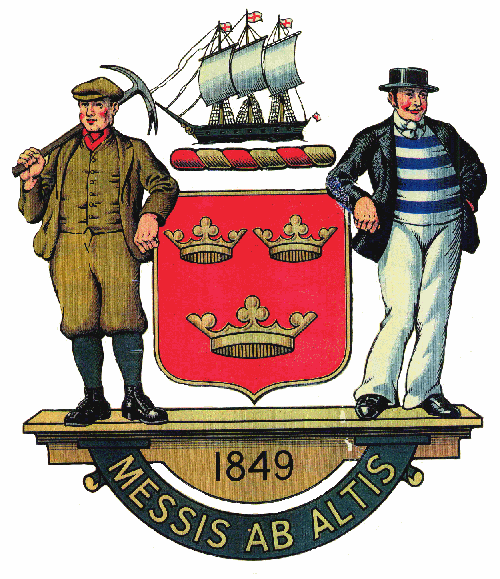
Above is the coat of arms adopted by the Borough of Tynemouth upon its formation in 1849. The various bits and pieces are all pretty self-explanatory (the motto means something like ‘harvest of the deep’ – coal and fish, get it?). But what exactly do the three crowns mean?

Well, the shield which lies at the centre of the emblem was adopted due to its being that of the Prior of Tynemouth. And the story goes that the three crowns represent the three kings buried within the priory’s walls, namely Oswin, Osred and Malcolm.

The earliest of these, King Oswin, was the ruler of the ancient kingdom of Deira, that portion of Northumbria which lay between the Tees and the Humber. The northern bit, Bernicia, was at the time ruled by another individual. In 651, however, that other individual, one King Oswy, attacked the southern kingdom, sending Oswin first into retreat, then into surrender. Sending his troops home to save their lives, he then gave himself up to the enemy (or was betrayed – sources vary), was murdered by them, and interred at Tynemouth. He was later elevated to sainthood.

King Osred II became ruler of a united Northumbria in c.788-89, but soon fell himself in 790 to the previously deposed Aethelred. Fleeing into exile, he returned for another crack at the top job in 792, but was slain – probably by Aethelred’s men – before he’d had a chance to get himself organised. His murderers at least had the decency to have him buried at Tynemouth Priory.

King Malcolm III of Scotland died doing what he did best; raiding Northumbria. He was forever at it, and eventually paid with it with his life when he was defeated and slain at the Battle of Alnwick in 1093. His remains were interred at Tynemouth – though they were later reburied next to those of his wife, Margaret, at Dunfermline Abbey in the thirteenth century.

If you’d like to know more about the crest, see www.tynelives.org.uk/northsh/page2.htm  


Friday, 24 September 2010

Coquet Island (NU294045)

 
This small island, one mile east of Amble off the Northumberland coast, has an eventful history for such a tiny wee place. It is now an RSPB reserve, of course, and a well-protected one at that, with no members of the general public permitted to land on its rocky shores. Even the lighthouse is now fully automated.
 
Not that it has ever been ‘populated’ to any great extent, you understand; hermits are those most closely associated with its barren 15 acres or so. St.Cuthbert spent a little time there, famously granting an interview to Elfed, Abbess of Whitby and sister of King Ecgfrith, during which he was effectively offered the bishopric of Lindisfarne. But the island is most closely tied to the solitary life of one St.Henry of Coquet.
 
Henry came to Coquet Island in the early 12th century, having been guided by a vision to make good his escape from an arranged marriage in his native Denmark and dedicate his life to a one in lonely praise of God. After a quick word with the powers-that-be at Tynemouth Priory, he ensconced himself on the rocky outpost and set about his calling. He lived a severely austere existence, surviving on only three small meals a week and gave up speaking for several years. His extreme mode of living brought much criticism from the monk formally in charge of the island – a manifestation of his envy, presumably, due to what can only be described as the ‘high standards’ of his vows of poverty – and cries aplenty from his relatives back in Denmark to return to the bosom of his family and a hermitage much nearer to home. Being afflicted by a “loathsome affection” to his knee, however, he insisted upon staying put.
 
He was credited with ‘second sight’, of course, as most of his type were. He saw lots of things others couldn’t, made premonitions, magicked up miracles, and was considered something of a wiseman. You know, the usual sort of thing. In early 1127, though, his ulcerated knee finally sent him on his way to the other side, with his remains being buried at Tynemouth Priory.