Showing posts with label Northumbria. Show all posts

Tuesday, 2 May 2017

The Battle of Heavenfield (NY937694)


Site of the Battle of Heavenfield, with 
St.Oswald’s Church in the distance.

The ‘Golden Age’ of Northumbria – the period of Dark Age cultural and military supremacy which spanned, roughly, the mid-seventh to the mid-eighth centuries – was probably the proudest phase of North-Eastern history. Out of this tumultuous century or so came the writings of Bede and the Lindisfarne Gospels (among other spectacular outpourings). And, as is so often the case with such epochs, it all came about as a direct result of a victory in the field – in this case the Battle of Heavenfield.

After the death of Edwin, king of Northumbria, in 632, the struggle was on for the overlordship of the English Heptarchy. Edwin had been the most prominent ruler of this patchwork of kingdoms which then existed in the land, and his demise very much put the cat squarely among the pigeons. Cadwallon, king of the Britons (Welsh) and Penda, a prominent Mercian prince – both of whom had scores to settle with the house of Northumbria – then unified in an alliance against the great northern kingdom. In the months following Edwin’s death, Northumbria was largely laid waste by this troublesome pair.

After months of turmoil, Oswald emerged from his long exile on Iona to seize the Northumbrian throne (his dynastic foes, Edwin and his sons, having been slain). Oswald, a son of Aethelfrith – who had ruled in Northumbria before Edwin – had grown up among the monastic community of Iona together with his younger brother, Oswy. They were both Christians of the Celtic/Irish bent, and determined that their father’s kingdom must be saved from pending collapse. Before Oswald could take the crown, though, Cadwallon and Penda would have to be swept from their old lands.

So, in late 633 (or 634), Oswald marched south with his warband – a motley collection of on-loan Pictish warriors and Irish monks, together with a few hundred Northumbrians which he was able to pick up on the journey south – until he reached the Roman Wall a little to the east of Chollerford. Cadwallon, on the other hand, moved north up Dere Street and along the Wall to the same point. It is likely that Penda did not take part in this phase of the war, though some of his forces may have been involved.

On the night before the battle, Oswald experienced a vision of St.Columba, who promised heavenly support for the young Northumbrian. A cross was erected before the battle, too, around which Oswald rallied his troops. Oswald’s subsequent attack – probably at night – proved devastating, and the Welsh were defeated with surprising ease. Using nearby Brady’s Crag and the Wall itself to their strategic benefit, the Northumbrians were able to nullify their numerical disadvantage – Cadwallon himself being slain in the rout, forever since known as the Battle of Heavenfield.

Oswald was then able to quickly stabilise the kingdom and take the throne. The threat from the Welsh and the Pagan Mercians had been put to bed, at least for the time being. Moreover, the new king dedicated his victory to God, eventually inviting Aidan to found his monastery at Lindisfarne, and thus sowing the seed of Christianity for the English nation-to-be…

… And hence laying the foundation for our ‘Golden Age’.


Tuesday, 14 March 2017

St.Acca of Hexham (NY936641)


When it comes to early Christianity in the North-East – and Hexham in particular – most casual history enthusiasts look no further than the likes of Cuthbert, Aidan and Bede. The hard-nosed, super-industrious Wilfrid also comes into the frame, too, of course, being the chap who founded Hexham Abbey and a great many other religious houses in the late 7th century AD. But every great man needs his lieutenants, and Wilfrid’s was a man by the name of Acca.

Acca was born in the ancient kingdom of Northumbria around 660, and initially seems to have served in the household of Bosa, the future Bishop of York; but he soon found himself under Wilfrid, probably by the time he was 20. From the late 670s through to Wilfrid’s death in 709, Acca accompanied the great man on his continental travels and served as first his protégé, then his fully-fledged right-hand man during his many high-ranking incumbencies.

In 692 Acca was appointed abbot of St.Andrew’s monastery, part of the Hexham Abbey/Priory set-up. Then in the later years of Wilfrid’s life he acted as the old man’s loyal and closest companion, eventually being named by Wilfrid himself as his successor as Bishop of Hexham in 709.

Acca threw himself into the running of the diocese with gusto, and completed the construction work begun by his mentor. He was a great theologian and rather keen on music, too, once bringing the great cantor, Maban, north for a visit. He was a great friend of Bede, who dedicated many of his works to him – such was his reputation as a cleric and all-round good egg. In short, he brought to completion all of Wilfrid’s Christian plans for both Hexham (including improving and ornamenting the church) and Northumbria (founding many churches, among other things), thus helping cement his predecessor’s legacy.

Acca presided as bishop for 23 years until, in 732, during a period of dynastic upheaval, he was forced to leave. It is not known for sure why he was obliged to flee, but it may have been due to his familial links with the exiting ruling family. Sources vary as to his destination – some say Whithorn or St.Andrew’s in Scotland, others say Ireland – but he eventually returned to Hexham when circumstances permitted, where he was warmly and reverently received. He died in the town at some point during 737-42, was interred near the abbey’s east wall and, in time, was raised to the sainthood. A remnant of one of the two crosses which marked his grave can be found inside the abbey today.


Tuesday, 31 March 2015

Carham: the Battles & the Border (NT798383 & thereabouts)


The tiny village of Carham lies in the very north-west corner of Northumberland, at the point where the Anglo-Scottish border breaks away from the line of the Tweed and cuts southwards across country towards the Cheviots. It is known for not one, but two, battles, of which the consequences of the second led to the establishment of the present-day frontier between the two nations.

Battle No.1 is a shadowy affair. It took place in 833AD between the Danes and the English, at a time when the border itself didn’t really exist (the whole region forming part of the kingdom of Northumbria). The Danes, who were ‘on the up’ at the time, were flexing their muscles against a declining Northumbria and routed the defenders, killing ‘eleven bishops, two counts and a great number of people’ in the process. Within thirty or so years, Northumbria was a puppet kingdom of the new-fangled Danelaw.

Whereas the 833 battle took place probably quite near to the village (a little to the south-west, we think), the second encounter in the early eleventh century more than likely occurred two or three miles to the east in a field between Wark and Coldstream (indeed, this second battle is sometimes called the Battle of Coldstream). And we don’t even know the exact year for this one – but it was either 1016 or 1018.

By this time the Scots were trying to exercise ever greater control over Northumbria’s northern lands (Lothian and what we now know as the Border counties), and it was they who seemingly provoked the flashpoint in question. Though England existed as a united nation at the time, the defence of the attack was left to a local Northumbrian army. And the Scots, led by King Malcolm II and Owain of Strathclyde, won the day.

The victory established Scottish rule in the present-day south-east area of Scotland, being essentially the land north of the Tweed - though there is some dispute about the significance of the battle, as the Lothian region may effectively have been ceded by the English much earlier. What is not in dispute, though, is that the (second) Battle of Carham put the matter beyond doubt.

This didn’t stop the Scots trying their very best to push the border ever southwards (most notably during 1139-57 when they ‘ruled’ as far south as the Tees). However, the boundary eventually fell back to the line of the Tweed as a result of the Treaty of York in 1237, where it has stayed ever since … apart from the odd little tweak here and there!


Tuesday, 17 March 2015

Norham and North Durham (NT899473)


Anyone who knows anything about the ancient history of Northumbria will be aware of the region’s strong links with early Christianity. Aidan, Cuthbert and Bede dominate the annals of our history from the former’s arrival here as a missionary in 635AD to the latter’s death exactly a century later. And the village we now know as Norham on the very edge of England overlooking the River Tweed played an important role in those formative years.

These days, of course, the castle is the great symbol of Norham’s place in history, but this fine structure didn’t appear in its earliest form until the 1120s. Unlike most other settlements in the North-East, the village had already enjoyed an eventful and quite well documented history up until this point, mainly due to its situate.

Skipping conveniently over its very earliest days, it came to prominence most notably at the dawn of Northumbria’s period of Dark Age dominance in the 630sAD. When King Oswald won the crown of the northern kingdom in 634 he invited the Celtic monks of Iona to establish Christianity in the region – and it was, of course, Aidan who made this happen. He was sent over from the little Scottish island in 635 and, by passing over the Tweed and through Norham en route, he first brought the village into the sightlines of the religious community.

Norham was then called Ubbanford (‘upper ford’), and though Lindisfarne soon became religious HQ, it has been suggested that Norham enjoyed a brief period of superiority beforehand. Even in later years it remained a regular monkish stopping-off point on their journeys to and from Iona. A grant of land was, in fact, made to create a monastery at Norham as early as 655.

The village’s religious links were reinforced during the ninth century when on at least one (and probably two) occasions, the remains of St.Cuthbert were moved there to keep them safe from Viking raids. By the mid eleventh century Ubbanford had become Norham, and was essentially the capital of the County Palatine of Durham’s lands in North Northumberland – or North Durham, as it was for centuries known. So, yes, Norham (or Norhamshire) and a good deal more of the northern reaches of Northumberland weren’t in Northumberland at all, really, from the medieval period to the Victorian era, but rather they were part of County Durham – a curious state of affairs brought on by the enduring religious heritage of these stretches of land. Amazingly, it wasn’t until 1844 that the common sense switch was made by handing North Durham to Northumberland. 

When the castle came along in the 1120s, it was a Bishop of Durham who commissioned it. Built to keep the incursions of the increasingly boisterous Scots at bay, it encouraged the development, in time, of the the village proper. Then another very different phase in Norham’s history began… as a military outpost.

But that’s another story.


Tuesday, 15 February 2011

Tynemouth’s Three Kings (NZ374695)


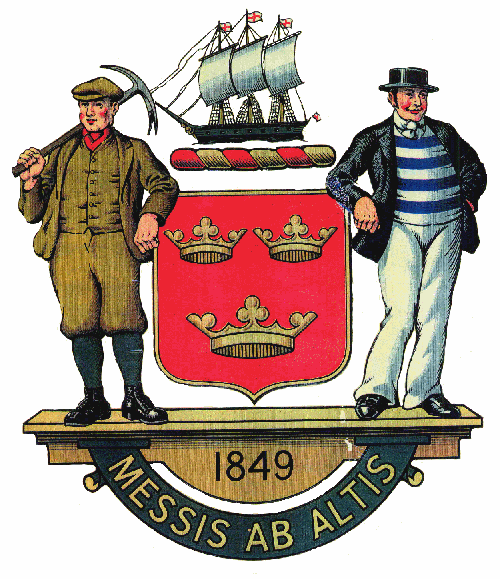
Above is the coat of arms adopted by the Borough of Tynemouth upon its formation in 1849. The various bits and pieces are all pretty self-explanatory (the motto means something like ‘harvest of the deep’ – coal and fish, get it?). But what exactly do the three crowns mean?

Well, the shield which lies at the centre of the emblem was adopted due to its being that of the Prior of Tynemouth. And the story goes that the three crowns represent the three kings buried within the priory’s walls, namely Oswin, Osred and Malcolm.

The earliest of these, King Oswin, was the ruler of the ancient kingdom of Deira, that portion of Northumbria which lay between the Tees and the Humber. The northern bit, Bernicia, was at the time ruled by another individual. In 651, however, that other individual, one King Oswy, attacked the southern kingdom, sending Oswin first into retreat, then into surrender. Sending his troops home to save their lives, he then gave himself up to the enemy (or was betrayed – sources vary), was murdered by them, and interred at Tynemouth. He was later elevated to sainthood.

King Osred II became ruler of a united Northumbria in c.788-89, but soon fell himself in 790 to the previously deposed Aethelred. Fleeing into exile, he returned for another crack at the top job in 792, but was slain – probably by Aethelred’s men – before he’d had a chance to get himself organised. His murderers at least had the decency to have him buried at Tynemouth Priory.

King Malcolm III of Scotland died doing what he did best; raiding Northumbria. He was forever at it, and eventually paid with it with his life when he was defeated and slain at the Battle of Alnwick in 1093. His remains were interred at Tynemouth – though they were later reburied next to those of his wife, Margaret, at Dunfermline Abbey in the thirteenth century.

If you’d like to know more about the crest, see www.tynelives.org.uk/northsh/page2.htm