Showing posts with label Deira. Show all posts

Friday, 1 June 2012

Sadberge’s Long History (NZ340168)


The village of Sadberge, a little to the east of Darlington, has one of those ancient-sounding place-names that you just know has a long and interesting history. And it has, though a good deal of it has always lain tantalisingly out of the reach of a succession of local historians.

What is known for sure is that a Roman road, Rykenield Way or Street, ran directly through the place, north-south, and that because of the settlement’s elevation, they probably maintained a signal station of sorts on the spot. Perhaps they even built a camp or a fort there, but no one has been able to find definitive evidence. Rumours persist of a later ‘Saxon castle’ in the vicinity of St.Andrew’s Church – perhaps a stronghold of the Dark Age Kingdom of Deira.

Next it was the Vikings. And it was they who gave the village its name – Sadberge deriving from ‘Set-berg’, meaning ‘flat-topped hill’. It became, in fact, the focus of their local wapentake (administrative centre), covering large tracts of land to the North of the Tees. Its status stuck for centuries thereafter, and became known as the ‘Earldom of Sadberge’.

It was so special, in fact, that it was not initially taken into the domain of the Prince Bishops of Durham in the early days of Norman rule – but was eventually added in 1189. It remained ‘special’, however, and continued to be administered almost as a separate county until deep into the 16th century.


Today is the blog's 2nd anniversary! 
See here.


Tuesday, 15 February 2011

Tynemouth’s Three Kings (NZ374695)


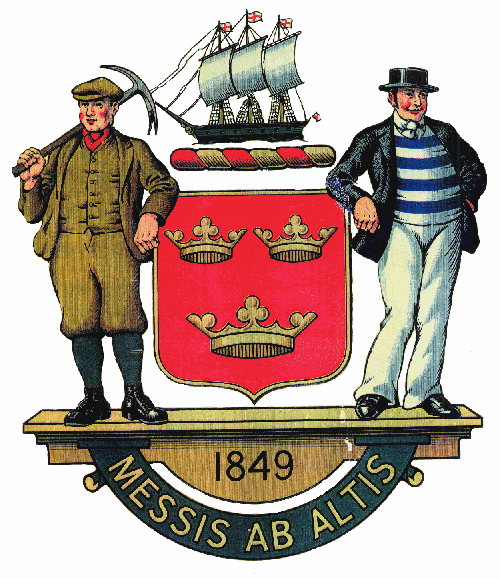
Above is the coat of arms adopted by the Borough of Tynemouth upon its formation in 1849. The various bits and pieces are all pretty self-explanatory (the motto means something like ‘harvest of the deep’ – coal and fish, get it?). But what exactly do the three crowns mean?

Well, the shield which lies at the centre of the emblem was adopted due to its being that of the Prior of Tynemouth. And the story goes that the three crowns represent the three kings buried within the priory’s walls, namely Oswin, Osred and Malcolm.

The earliest of these, King Oswin, was the ruler of the ancient kingdom of Deira, that portion of Northumbria which lay between the Tees and the Humber. The northern bit, Bernicia, was at the time ruled by another individual. In 651, however, that other individual, one King Oswy, attacked the southern kingdom, sending Oswin first into retreat, then into surrender. Sending his troops home to save their lives, he then gave himself up to the enemy (or was betrayed – sources vary), was murdered by them, and interred at Tynemouth. He was later elevated to sainthood.

King Osred II became ruler of a united Northumbria in c.788-89, but soon fell himself in 790 to the previously deposed Aethelred. Fleeing into exile, he returned for another crack at the top job in 792, but was slain – probably by Aethelred’s men – before he’d had a chance to get himself organised. His murderers at least had the decency to have him buried at Tynemouth Priory.

King Malcolm III of Scotland died doing what he did best; raiding Northumbria. He was forever at it, and eventually paid with it with his life when he was defeated and slain at the Battle of Alnwick in 1093. His remains were interred at Tynemouth – though they were later reburied next to those of his wife, Margaret, at Dunfermline Abbey in the thirteenth century.

If you’d like to know more about the crest, see www.tynelives.org.uk/northsh/page2.htm