Showing posts with label Pevsner. Show all posts

Tuesday, 24 June 2014

Attractions of Milbourne (NZ113743 & NZ117751)


© Copyright Les Hull and licensed for reuse under this Creative Commons Licence.

The village of Milbourne, a little to the NW of Ponteland, is dominated by the Georgian hall of the same name. Built during 1807-09, Milbourne Hall was thrown up by the Bates family to the designs of Edinburgh architect John Paterson and is a standard-looking affair. Constructed of local sandstone collected from the nearby Belsay quarries, its external demeanour belies its curious internal secret: for almost every room within is oval in shape. In a similar vein, the mansion’s stable block is octagonal in its layout. As the house is a private dwelling, we’re unlikely to ever bear witness to these geometrical curiosities, so we’ll have to place our trust in my Pevsner’s guide.

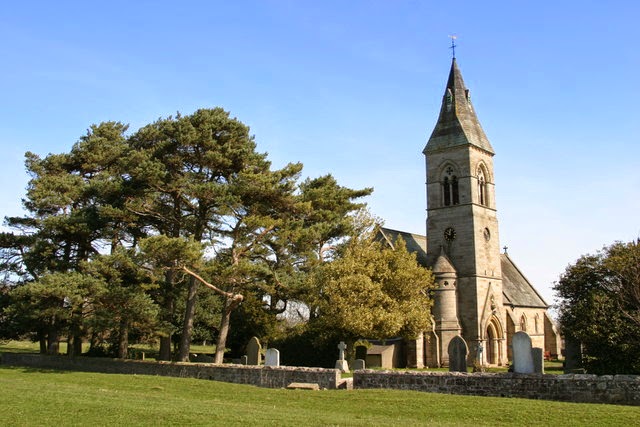
 © Copyright Phil Thirkell and licensed for reuse under this Creative Commons Licence.

As part of the Bates’ development of the general vicinity, a slightly eccentric chapel-of-ease was also constructed in the village in 1869 by Miss Jane Anne Bates. Intended to save her family, the villagers and the staff of Milbourne Hall the long walk into Ponteland every Sunday, the little building of the Holy Saviour has since proved to be quite a success – right through, in fact, to the present-day. For many religious Pontelanders now make the reverse trip to Milbourne every Sabbath in order to avail themselves of the picturesque facilities in and around the Bates’ Victorian creation.

Tuesday, 7 August 2012

Wynyard: the Best in the Land (NZ421257)


Wynyard Hall, c.1880

The Wynyard Hall/Park Estate, a few miles north of Stockton-on-Tees, has long been a beauty spot. Though the current magnificent mansion dates from a two-pronged building programme spanning 1822-41 and 1842-46 (divided by a catastrophic fire), its history – and reputation – as a site of splendour goes back many centuries.

In the mid-1600s, for example, it was described as fruitfull of soile and pleasant of situation, and so beautified and adorned with woods and groves as noe land in that part of the country is comparable unto them. In the ensuing two centuries, various avenues, terraces and gardens were added to enhance the landscape, until the Grecian mansion was added as per above. It was the 3rd Marquess of Londonderry who was responsible for the construction of the present edifice – the famous coal magnate himself – and it was at the brand new hall that, in 1847, a lavish birthday bash was laid on:


Amongst the distinguished company present was Prince Louis Napoleon, afterwards Emperor of France. On this occasion there was a curious card party, which deserves to be made historical. The gentlemen who took a hand in it were Louis Napoleon, Benjamin Disraeli, George Hudson (the Railway King), and J.J.Wright of Sunderland.

Disraeli, in fact, loved the place. On leaving London for a trip to Wynyard he once said, “I never left London with such a sense of relief and such anticipation of happiness.” More recently, Nikolaus Pevsner described the hall as “the most splendid 19th century mansion in the country.”

Royalty and the social elite have frequented the establishment, including visits in the Victorian era by Edward Prince of Wales and later by Queen Elizabeth II. 


In celebration of the 2012 Olympics, GenesReunited are currently offering 20.12% off their Platinum subscription (offer runs until midnight on Sunday 12th August). Click below and jump to the 'subscribe' section.

ancestor, ancestry, family tree, family history, r


Friday, 19 November 2010

North Seaton Hall (NZ297866)


You can barely imagine it today, but in the middle of a 1960s housing estate in North Seaton, near Ashington, there once stood a fine classical house which went by the name of North Seaton Hall. Pictured above in its declining years, it may even hold the distinction (according to his daughter) of being architect John Dobson’s very first commission in 1813.

However, there was without doubt a building already on the site – and known by the same name – throughout most of the eighteenth century. Directories give 1710 as a possible starting point, when the Watsons were in early residence. It is more likely that Dobson carried out alterations in 1813 – and was most certainly back on the estate in 1831 to add some outbuildings (workers’ cottages and, possibly, the Gothic lodge).

The grounds occupied a wooded site north of the present B1334, near to the junction with the A189. The Watsons remained in residence until deep into the Victorian era, the estate falling into the hands of prominent industrialist Sir Isaac Lowthian Bell in the 1880s. In the 1950s, Pevsner noted the hall’s “very neglected” state; and in 1960 it was razed to make way for modern housing.