Showing posts with label Eglingham. Show all posts

Tuesday, 16 June 2015

Ingram Oddities (NU019163)


You never know what you’re going to find when you poke around an old graveyard. And if you look closely enough you’re sure to find an oddity or two in almost any such site. Take St.Michael & All Angels Church at Ingram which lies at the eastern gateway to the Cheviots – for it has two such curiosities.


The first is a gravestone to James & Isabella Armstrong, residents of High Bleakhope (a remote farm higher up the Breamish valley) – James, according to one source, being a “well known and much esteemed Border Yeoman.” They died in 1914 and 1951, respectively. The beautifully rounded stones were taken from the River Breamish near their farmstead. Apparently, Isabella’s sister, Elizabeth, has a similar headstone at Eglingham.

[thanks to Skida’s image and info at http://www.panoramio.com/photo/14739820#comments ]


In the same churchyard can be found a simple cross atop a rough, unhewn boulder. The inscription says it all:

Together
in this grave lie
Isabella Allgood aged 42
James Charles Allgood aged 13
David Williamson Allgood aged 11
the beloved wife and sons of
James Allgood rector of Ingram
who were killed in an accident
on the Great Northern Railway
at Abbot’s Ripton January 21 1876

They were lovely and pleasant in
their lives and in their deaths
they were not divided

[thanks to Northernvicar at https://northernvicar.wordpress.com/2012/09/26/ingram-st-michael-and-all-angels/ for the info and image]


Tuesday, 9 December 2014

Henry Ogle: Not to be Messed With (NU104195)


Eglingham Hall, like most buildings of its type, started small and has been added to considerably over the years. It began as a pele tower and today looks like this:

© Copyright Stephen Richards and licensed for 

When its development was somewhere in between, one Henry Ogle lived there for a time prior to his death in c.1669. He was a staunch Parliamentarian, and was at his most boisterous – nay, cocky – during the days of Cromwell. Around 1649-50 he was involved in two instances for which we have precious little information, but which nevertheless provide a neat little window into what was, at the time, a pretty crazy world.

The first occurred in the wake of the famous Newcastle Witch Trials of 1649. From Thomas Oliver’s A New Picture of Newcastle-upon-Tyne of 1831:

1649 – The Magistrates of Newcastle sent to Scotland for a man who pretended to discover who were witches: on his arrival the bellman went through the town, crying “all persons who would bring in any complaint against any woman for a witch, they should be sent for and tried by the person appointed.” Thirty women were brought into the town-hall, stripped there, and had pins thrust into their bodies, and most of them condemned for witches!

As a result, fourteen witches and one wizard were executed. The account continues…

The witch-finder went from Newcastle to Northumberland, when [magistrate] Henry Ogle, Esq. laid hold of him and required bond to answer at the sessions, he escaped into Scotland, where he was apprehended, cast into prison, and condemned; when on the scaffold he confessed that he had been the death of 220 women in England and Scotland, for the gain of 20 shillings each!

No one knows for sure who this notorious witch-finder was, but it may have been the infamous John Kincaid (however, Kincaid was not collared and executed until 1662, so there may be some confusion here).

Henry Ogle of Eglingham Hall may have played a prominent role in the casting out from the region of the pesky witch-hunters, but a year later he had a run-in with his ‘hero’ Oliver Cromwell, who, on the way to the Battle of Dunbar in 1650, stayed over at Henry’s house. Legend has it that the next morning the two of them quarrelled (over exactly what we don’t know), and that they may even have duelled over the disagreement.

I should think that their differences were soon patched up, though, as Henry was elected MP for the county in 1653 and 1654. But the story of the little dispute lived on, and inspired the poem Cromwell’s Visit: An Eglingham Legend by James Hall … and if anyone out there has the text of the said ditty I’d like to hear from them!


Would you like to write a post for the 'North-East History Tour'? 
Click here for further details.
Don't be shy!

Tuesday, 2 December 2014

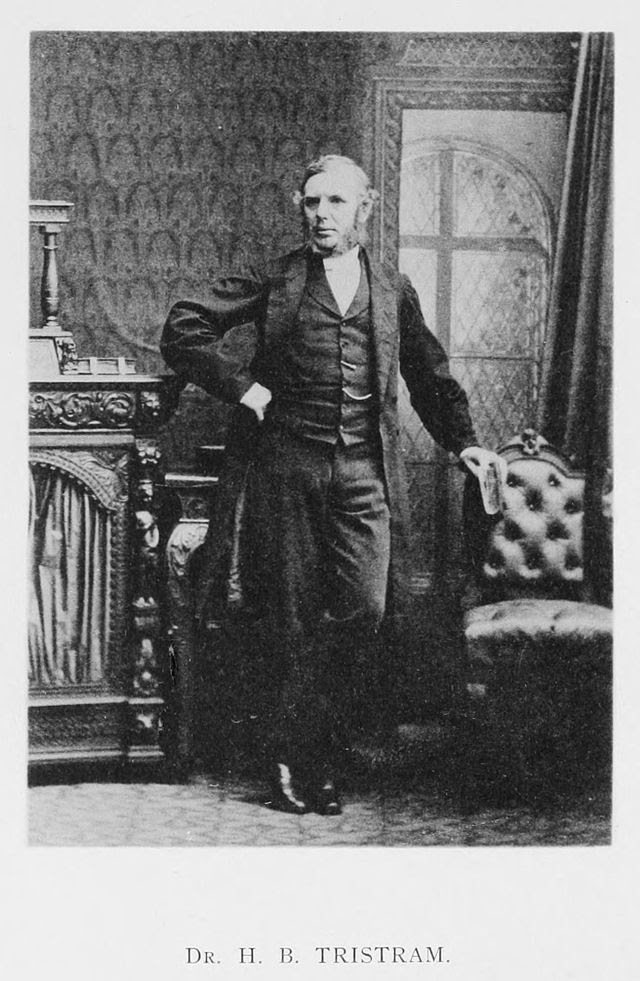
Eglingham’s Wandering Cleric (NU106195)


Canon Henry Baker Tristram was an English clergyman, naturalist, Biblical scholar and traveller. Somewhat controversially for his time, he was an early convert to Darwinism, and spent many years attempting to reconcile the theory with his religious beliefs.

Tristram was born at Eglingham vicarage in 1822 – the eldest son of the vicar – and studied at Oxford. He was ordained a priest in 1846, but his fragile health (TB included) forced him to live abroad. He travelled widely, including a stint as secretary to the governor of Bermuda from 1847 to 1849, where an interest in birds blossomed – but on returning to UK shores found the winters too much for him. Several expeditions to Algeria followed, including exploration of the Saraha desert and yet more ornithological adventures – and wrote a book entitled The Great Sahara. He first visited Palestine in 1858, returning there several times, where he expanded his collection of birds and identified possible Bible sites. Amidst all of this he became canon of Durham Cathedral in 1873, though his travels continued, including the Middle East and also Japan where his daughter spent decades working as a leading light at the Church Missionary Society’s School for Girls.

His infamous link with Darwinism began in the late 1850s when he was seduced by the writings of the great evolutionist. Looking at his own collections of birds, he became convinced of the validity of the new-fangled theory, and penned articles in support of the same.

Tristram, who was a Fellow of the Royal Society, wrote books, papers and articles of all his various adventures, concerned mainly with naturalism and the topography of the Bible lands. His sizeable collections of birds and eggs ended up in Liverpool’s World Museum and the Natural History Museum, London. And as any ornithologist will know, a number of birds are now named after him … as well as a breed of gerbil!

He died in 1906 and has a window dedicated to his memory in the north aisle of Eglingham Church.


Would you like to write a post for the 'North-East History Tour'? 
Click here for further details.
Don't be shy!