Tuesday, 29 March 2011

Tyne Dock (NZ353655)


Between (the now filled in) Jarrow Slake and the western edge of South Shields sits a very distinct corner of Tyneside known as Tyne Dock. Named after the large dock which eats into the river’s southern bank, it is as easily identifiable on maps as almost any other geographical feature in the region. Which makes it a bit of shame that it has now almost gone, and is unlikely to feature in blue on the next edition of the OS map.

Incredibly, the Tyne Dock basin was dug out by hand in the 1850s – much of it by veterans returning from the Crimean War. As part of the general industrial surge of the day, it was deemed necessary to create births for the growing river traffic – and the new ‘marina’ could take, it was said, some 500 vessels. Opened in 1859, Robert Stephenson made the dock gates and William Armstrong made the engines to power them – and they were still in use until about 20 years ago. But it was the drive of Jarrow shipbuilder Charles Palmer which saw the dock’s construction brought to a conclusion. Keen to compete with the railways in the transportation of coal, the great yard was Palmer’s response – built to take mighty new colliers such as the John Bowes.

A proud community grew up around the dock, of course – much of it made famous by the novels of Catherine Cookson, who was born at 5 Leam Lane, Tyne Dock in 1906, just as the yard was approaching is peak. With the decline of the industry and the growth in the sheer size of visiting ships, the dock’s usefulness began to fall off.

Inevitably, the developers’ eyes began to turn to the possibility of reclaiming the watery 50 acre site. In the 1980s, much of the southern area of the dock was in-filled, reducing its size by a good two-thirds. Then, in November 2009, a decision was made to complete the process by using material dredged and dug from the river during the excavation of the second Tyne Tunnel. This process has now been completed, and only a small sliver of the old Tyne Dock remains – to be filled with spoil as and when it becomes available.

Then the area will be ready for new commercial development. That’s progress for you.

There’s a neat little piece here about Tyne Dock and its community.


Friday, 25 March 2011

King Ecgfrith’s Port (NZ345655)


Jarrow Slake, that oddly-named area of reclaimed land on the south bank of the Tyne neighbouring St.Paul’s Church, has a recorded history going back to the time of Bede. The area was then a large expanse of mud-flats into which the River Don wound before emptying itself into the Tyne – but at high tide would fill with water, hence its original name of ‘King Ecgfrith’s Port’, named after the Dark Age Northumbrian king who gifted the land to the monks of Jarrow.

In time, a new name came into use: Jarrow’s Lake – which in turn became corrupted into Jarrow Slake. Little more than a treacherous expanse of gooey mess – as well as an unofficial bird sanctuary – for centuries, it was eventually put to good use in Victorian times as a pond for timber seasoning, for which it served its purpose for around a century from the 1870s. The Slake was also home to an isolation hospital for several years from around 1930, to which access was gained via a catwalk.

In 1972, reclamation work began, and the area was used as a landfill site for some time. Eventually amalgamated into the surrounding landscape, the Slake’s 120-acre muddy expanse finally disappeared for good in the early 1980s. Latterly it has been used as a car distribution terminal for Nissan.

For some fabulous photos of the old Slake, see here. And the area, on a map, as it is now – still, pleasing, called Jarrow Slake!


P.S. The illustrated gibbeting is probably that of William Jobling in 1832 (but that’s another story, see here). Though there is no sign of the cage, the artist may have omitted it in error.


Tuesday, 22 March 2011

The Oldest Stained Glass Window in the World (NZ338652)


Well, sort of. It is certainly the oldest stained glass that is known to still form part of a window – but we’ve cheated a bit, because this rather random mosaic was thrown together by craftsmen thirty-odd years ago using pieces of ancient glass turned up in a dig in the 1970s.

Professor Rosemary Cramp had been poking around archaeological sites in both Jarrow and nearby Monkwearmouth for more than a decade before she fell upon the above specimens in a particularly significant find at the former site during 1973-74. A decision was soon made to put them on display in the surviving Anglo-Saxon chancel at St.Pauls, the 7-inch diameter window ever since being claimed as the world’s oldest of its type.

The thing is, similar fragments found at Monkwearmouth are probably older, based on the theory that the Wearside monastry pre-dated that at Jarrow by about a decade (670s as opposed to 680s). Though it is not possible to accurately date glass, the Venerable Bede’s writings confirm that such glass was being fitted in the North-East monastries from around 675 – which means that Monkwearmouth must have had it first, followed by Jarrow when it was itself constructed a little later.

So, there you have it: yet more Tyne-Wear rivalry, this time with the Wearsiders coming out, we think, on top. But until they get their bits and pieces into a functioning piece of kit, the Tyne will still have the oldest stained glass window in the world. Well, as I say, sort of.

More reading here and here.


P.S. Fragments of glass from the Monkwearmouth site can be found on display at several locations throughout Sunderland, namely, St.Peter’s Church, Sunderland Museum & Winter Gardens and (from April 2011) The National Glass Centre. Bede’s World Museum, Jarrow, contains fragments from its own site, in addition to that on display in situ in the old church itself.


Friday, 18 March 2011

St.Bede’s Well, Hebburn (NZ321641)


A nondescript hole in the ground in a corner of a patch of landscaped ground in Hebburn is the spot in question. Presumably an old natural spring of sorts, it used to sit little more than a yard from the old Bede Burn which meandered this way - a waterway which now lies buried under (or perhaps diverted around) the modern paved area which frames the well itself.

Legend has it that the famous Bede drew water from the well as a boy, and later sent monks there to fetch water when he was a priest at nearby St.Paul’s Monastery. All very fanciful, though there has been some recent speculation that the ‘bede’ in question derives from the Anglo-Saxon word baed, meaning a bathing place. Local historian Brand stated that in the 1740s it had long been a custom to bring sick and disabled children to the spot to be dipped in the healing waters, after which a crooked pin would be dropped into the little pool. Midsummer’s Eve would also bring the locals to the site in large number for various festivities, including bonfires, music, dancing and sports.

Until the urban spread of the late Victorian era, the well and its immediate environs were something of a beauty spot. The incursions of industry and the like changed the area beyond recognition as the Edwardian era blew in, and the site underwent many changes during the twentieth century – but has somehow managed to hang on to its place on the modern OS map as a site of antiquarian interest in the area now known as Campbell Park.

For an excellent picture history of the site, see here.


Tuesday, 15 March 2011

The Tyne Tunnels (NZ330660)


The Tyne Tunnels are a series of three byways (pedestrian, cycle and vehicular) which pass under the River Tyne between Jarrow on the south bank and Howdon on the north. The road tunnel forms a section of the main arterial A19 trunk road.

They were constructed during 1947-67 as a result of the passing of the Tyne Tunnel Act – though the scheme had been proposed a decade previously by the Durham and Northumberland county councils. Post-war frugality delayed the vehicular underpass, but the pedestrian and cycle tunnels were completed and opened by 1951 – both stretching some 900ft and lying around 40ft below the river bed. The huge wooden escalators at either end are record-breaking constructions in their own right, but will soon be superseded by more modern affairs.

The much larger and longer (5,500ft) road tunnel was eventually completed in 1967, and was ‘opened’ by The Queen on 19th October of that year (though it was not opened to traffic until 1968). It has always been a toll tunnel – originally 2s 6d for cars (now £1.20).

A second vehicular tunnel was completed in February 2011, and, as I write, the old tunnel is undergoing a period of closure for renovation. The new ‘double-tunnel’ will then be re-opened fully in December 2011, by which time the revamp of the pedestrian-cycle tunnel will be well underway. By the end of 2012 all of the tunnels should be fully functional and modernised – though the wooden escalators will be preserved for posterity. After all, the tunnels are Grade II listed.


Friday, 11 March 2011

RMS Mauretania (c.NZ301655)


RMS Mauretania is, or rather was, the most famous ship ever built on the Tyne. It emerged from the Swan, Hunter & Wigham Richardson Yard at Wallsend in 1906 – the largest and fastest vessel in the world at its launch. She was one of the most iconic ships in maritime history – the flagship of the Cunard Line and holder of the transatlantic Blue Riband for 22 years from 1907.

The construction of the ship took around two years prior to its launch on 20th September 1906. She sat in the river for a further year being fitted out to her famous high standards, and commenced trials in September 1907. She left the river amidst great ceremony the following month to be delivered to Liverpool, where the world’s largest moving structure embarked upon her maiden voyage in November 1907.

She plied her passenger trade across the Atlantic for several years, stacking up the speed and time records – making 88 perfect crossings of the ocean during 1908-11 alone at an average speed of over 25 knots.

During the Great War, Mauretania was requisitioned by the Admiralty. She was only ever armed during her wartime service towards the end of hostilities, but helped 10,000 troops on their way to the doomed Gallipoli campaign, narrowly avoided being torpedoed, and was latterly converted into a hospital ship. She also transported troops hither and thither as needs required, including taking many soldiers back home to North America after the war.

She returned to her Cunard service in 1919, but wear and tear soon began to show. An on-board fire then brought her home for a refit on the Tyne during 1921-22 – prompting great local celebration – before returning to her glorious transatlantic best. Cruises were also by then a part of her remit, carrying some of the world’s richest folk around the Mediterranean and further afield. A further upgrade to her machinery in 1923 at Southampton and Cherbourg provided a further boost to her career. She finally lost the prestigious Blue Riband to the German ship Bremen in 1929.

She spent her latter days cruising the Caribbean, where a repaint earned for her the nicknames “The White Queen” and “The Wedding Cake”. Finally withdrawn from service in 1934, she sailed back to Southampton, was stripped, and, in 1935, was taken to the breakers yard at Rosyth. As she passed the mouth of the Tyne on her way north, thousands of mourners lined the shore, a flotilla buzzed lovingly around her creaking bulk, and local dignitaries paid their last respects in an on-board ceremony. The Mauretania then disappeared out of sight and into history.

For more information see here.


Tuesday, 8 March 2011

Wallsend and The Grand Duke (NZ310664)


As part of the Europe-wide celebrations following the overthrow of Napoleon, a state visit to the UK was arranged for Alexander I, Emperor of Russia, in 1816. Accompanying Alexander was his 20-year-old younger brother (and future Emperor), The Grand Duke Nicholas. It was a holiday the young man would never forget.

Nicholas must have fancied himself as something of a man of the world; an adventurer even. For, breaking free of the royal party, he determined upon some new personal experiences as part of what he must have considered to be his exciting ‘alternative tour’. Top of his list of ‘must-dos’ seems to have been to visit a coal mine; and so, in view of the pit’s famed reputation, he was ushered north to Wallsend Colliery.

The esteemed dignitary’s arrival sparked a burst of regionalistic verve. Wearside welcomed him first, with a visit to the river’s then famous bridge; before moving onto Newcastle and an introduction to Thomas Bewick, among others. Eventually arriving at Wallsend on 16th December 1816, he was given a prolonged tour of the colliery site, before being invited to change out of his glittering finery and into a deputy-overman’s outfit, prior to being escorted to the gaping hole that was the pit-head.

The chosen mode of descent for The Grand Duke was considered the safest of its day. This involved the riding of a large iron hook at the end of a long rope, by which he was told to cling to firmly, whilst keeping himself clear of the black and dripping walls with a short stick during his long, slow drop.

At the time, Wallsend Colliery was one of the most profitable in the land and produced the very finest quality coal. The visit was meant to impress and enlighten, but ended up delivering a little too much in the way of information. For when Nicholas was brought to the very edge of the pit and looked down into the abyss, he stepped back hurriedly, holding up his hands in horror, exclaiming in French, “Ah! My God! It is the mouth of hell! None but a madman would venture into it!”

He hastily retreated, changed quickly back into his splendid military attire, and left Wallsend Colliery as fast as his carriage would carry him.


Friday, 4 March 2011

Wallsend’s Old Church (NZ305673)


Residents of the North Tyneside town will be familiar with their form, but many from further afield may not even be aware of the existence of this curious collection of stones. They stand in open fields between the town centre to the south and the Coast Road to the north, equally forgotten and ignored by both, apart from, that is, occasion visits by graffiti merchants.

Built in the twelfth century with stones robbed from the Roman Wall, the Church of the Holy Cross was almost certainly constructed by the monks of Jarrow Priory in whose parish it then lay. It seems to have been used for public worship until 1798, by which time it had become so dilapidated that it was abandoned – a half-baked plan of repair leaving the building roofless and utterly unrecoverable. Much of the stone was requisitioned for the building of a barn and stable-block for the nearby parsonage, with the flock adjourning to a school-room for their services for nigh on a decade.

By-and-by a new church – that of St.Peter’s – was built and consecrated in 1809, and the old building was left to crumble. The image above dates from 1887; and in 1909 the site was tidied and a fence erected to help protect the remains.

And as you can see, here, they haven’t changed much over the years.


Tuesday, 1 March 2011

North Shields’ Wooden Dollies (NZ358683 & NZ355685)


‘Wooden Dolly’ statues have been a part of the history of North Shields for 200 years. There have been many incarnations over the years, beginning with a ship’s figurehead, morphing into a fishwife – and lately returning once again to its original form.

It all began in 1781, when a collier brig by the name of the Alexander and Margaret was attacked and ransomed on the high seas. Some time later, in 1814, the ship’s female figurehead somehow found its way to the town, where it was placed at the entrance to the Customs House Quay, on Liddell Street. In time, a tradition grew up among the local mariners to shave pieces from the figure to take with them to sea as good luck charms. This led to its repeated defacement and replacement – firstly in 1850, then in the 1860s, and again in 1901 when Dolly No.4 was raised, this time in the shape of a fishwife.

But that wasn’t the last of it. Most of us have grown up with Dolly No.5, being the replica fishwife placed in Northumberland Square in 1958 (which still survives). But lately – in 1992 – a sixth statue has appeared in the very same spot previously occupied by numbers 1-4, being a throw-back to the original ship’s figurehead. This can be seen at Custom House Quay next to the Prince of Wales pub.

Check them out here…

Friday, 25 February 2011

William Harbutt: Inventor of Plasticine (NZ355682)


Plasticine is one of those toys with which we all played during our childhood, surely without exception. And it was invented by one William Harbutt, who was born in North Shields.

Harbutt entered this world in 1844, the seventh of eight children of Thomas Harbutt, who ran a local galvanising works which served the Tyne shipyards. Little is known of his early life, though he ended up at the National Art Training School in London – eventually becoming a teacher of art and an associate of the Royal College of Art.

In 1874 he became headmaster at the Bath School of Art and Design, and in 1877 opened his own art school together with his artistically talented wife, Bessie. At some point in the 1890s (1895 or 1897, accounts vary), he developed the new-fangled modelling clay out of utter frustration at the materials currently available for use by himself and his sculpture students. Crucially, it was non-drying, as well as being non-toxic and extremely malleable – though its exact composition is still kept a closely-guarded secret even today.

He was granted a patent in 1899, and commercial production began in Bathampton in 1900. Originally grey, the range of colours soon expanded as its popularity as a toy among children grew. It continued to be manufactured in Bathampton until 1983. Harbutt himself travelled widely to promote his invention, and died of pneumonia whilst on a trip to New York in 1921, aged 77.

For an interesting little piece on plasticine, see here.


Tuesday, 22 February 2011

The Collingwood Monument (NZ372691)

 
© Copyright Ken Brown and licensed for reuse under this Creative Commons Licence.


This Monument

was erected in 1845 by public subscription to the memory of

Admiral Lord Collingwood,

who in the “Royal Sovereign” on the 21st October 1805, led the British Fleet into action at Trafalgar and sustained the Sea Fight for upwards of an hour before the other ships were within gun shot, which caused Nelson to exclaim “See how that noble fellow Collingwood takes his ship into action”.

He was born at Newcastle-upon-Tyne 1748 and died in the Service of his country, on board of the “Ville de Paris” on 7th March 1810 and was buried in St.Paul’s Cathedral.

The four guns upon this monument belonged to his ship the “Royal Sovereign”


This magnificent tribute to one of the region’s greatest historical figures stands overlooking the entrance to the River Tyne at Tynemouth. The statue is the work of John Graham Lough and stands atop a formidable pedestal designed by John Dobson. The cannon were added in 1849, four years after its original completion.


Friday, 18 February 2011

The UK’s First Volunteer Life Brigade (NZ374691)


Formed in 1864, the Tynemouth Volunteer Life Brigade was a true trailblazer in the annals of sea rescue. On 24th November of that year, a huge storm drove two vessels, The Friendship and The Stanley, onto the Black Middens rocks at the mouth of the Tyne and, amidst the confusion, none of the available lifeboats went to their immediate aid, each thinking the other had already launched. By the time a proper rescue attempt was made, lives were already being lost, until the count reached a total of 32 – all within yards of the watching crowd.

As a result of the confused rescue attempt, three men, John Morrison, and brothers, Joseph and John Foster Spence, got their heads together and decided that it’d be a good idea to train a band of locals to assist the ‘emergency services’ in times of need. The response at the specially convened public meeting of 5th December was huge, with over 100 men signing up on the spot.

The notion of ‘volunteer brigades’ became so popular that the idea was soon rolled out across the land, with the Board of Trade circulating the Tynemouth Brigade’s rule-book to coastguard stations throughout the UK. In time, dozens of new bodies were formed to offer their assistance to the local HM Coastguard Stations. Thus, the still-existent Tynemouth Volunteer Life Brigade, established in 1864, can rightly claim to be responsible for the founding of the national Coastguard Rescue Service, which continues to perform its supporting role to the mainstream rescue services today.

The TVLB’s website can be found at http://www.tvlb.org/


Tuesday, 15 February 2011

Tynemouth’s Three Kings (NZ374695)


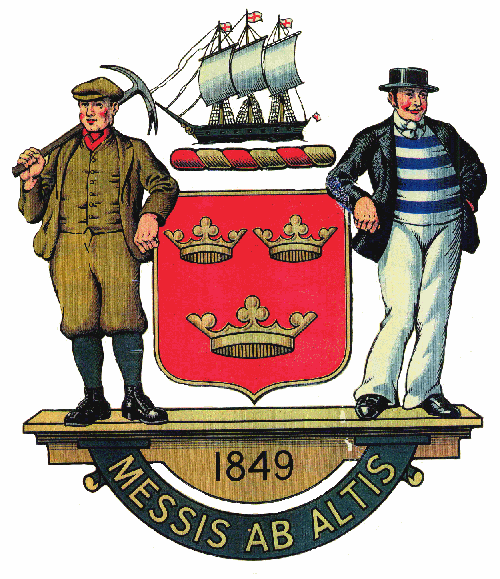
Above is the coat of arms adopted by the Borough of Tynemouth upon its formation in 1849. The various bits and pieces are all pretty self-explanatory (the motto means something like ‘harvest of the deep’ – coal and fish, get it?). But what exactly do the three crowns mean?

Well, the shield which lies at the centre of the emblem was adopted due to its being that of the Prior of Tynemouth. And the story goes that the three crowns represent the three kings buried within the priory’s walls, namely Oswin, Osred and Malcolm.

The earliest of these, King Oswin, was the ruler of the ancient kingdom of Deira, that portion of Northumbria which lay between the Tees and the Humber. The northern bit, Bernicia, was at the time ruled by another individual. In 651, however, that other individual, one King Oswy, attacked the southern kingdom, sending Oswin first into retreat, then into surrender. Sending his troops home to save their lives, he then gave himself up to the enemy (or was betrayed – sources vary), was murdered by them, and interred at Tynemouth. He was later elevated to sainthood.

King Osred II became ruler of a united Northumbria in c.788-89, but soon fell himself in 790 to the previously deposed Aethelred. Fleeing into exile, he returned for another crack at the top job in 792, but was slain – probably by Aethelred’s men – before he’d had a chance to get himself organised. His murderers at least had the decency to have him buried at Tynemouth Priory.

King Malcolm III of Scotland died doing what he did best; raiding Northumbria. He was forever at it, and eventually paid with it with his life when he was defeated and slain at the Battle of Alnwick in 1093. His remains were interred at Tynemouth – though they were later reburied next to those of his wife, Margaret, at Dunfermline Abbey in the thirteenth century.

If you’d like to know more about the crest, see www.tynelives.org.uk/northsh/page2.htm  


Friday, 11 February 2011

Dial Cottage, West Moor (NZ274705)


Still standing on the Great Lime Road a little to the south of Killingworth, this splendid little relic of the past was home to George Stephenson and his young family during the early years of the nineteenth century. George was just starting out on his incredible career when he moved into the cottage – as a brakeman in charge of winding machinery at nearby West Moor Colliery – but was internationally famous by the time he relocated to Newcastle twenty years later.

When our man moved in, the cottage consisted of one room and a garret reached by a ladder. During his stay, though, he extended and converted the premises into a four-roomed house. The cottage has a sundial above the door, made by Stephenson himself, and an adjoining plaque which reads:-

George Stephenson. Engineer. Inventor of the Locomotive Engine. Lived in this cottage from 1805 to 1823; his first locomotive (Blücher) was built at the adjacent colliery wagon shops, and on July 25th 1814 was placed on the wagonway which crosses the road at the east end of this cottage.
George’s baby daughter and wife died during 1805-06, leaving George and his infant son as the only surviving family members. Dial Cottage therefore doubles its fame as the childhood home of the great Robert Stephenson…
 

Tuesday, 8 February 2011

Winslow Homer’s Cullercoats Period (NZ364715)


No one really knows why, but in the spring of 1881 eminent American painter, Winslow Homer, chose to spend eighteen months of his life in the Northumberland coastal village of Cullercoats. It was a period of his life which resulted in a widely acknowledged improvement in his artistic style and not a little fame for the fishing community itself.

The Bay Hotel, demolished as recently as 2005, was the great man’s home during his extended stay (then known as the Hudleston Arms Hotel). He maintained a studio across the road at No.12 Bank Top (demolished 1930), which enjoyed fine views out to sea and over the harbour.

Homer remained in the village until November 1882. A very private man, he was left in peace by the residents, who were no doubt used to his type, Cullercoats being something of a magnet for artists during 1870-1920 (other notables included Henry H.Emmerson, Robert Jobling, Arthur H.Marsh, Isa Thompson, John Falconer Slater and John Charlton). Homer was fascinated by the disappearing old ways of the fisherfolk, especially the fisherwives, who adorn many of his canvases. The images are sober, unfancy affairs, with an edgy realism – a style which was new to the artist, and which won him much admiration on his return to the States in late 1882: “He is a very different Homer from the one we knew in days gone by”; now his pictures “touch a far higher plane...They are works of High Art.”

An apartment block called Winlsow Court now stands on the site of the old Bay Hotel.

For a selection of Homer’s paintings of the village, see www.cullercoats.pwp.blueyonder.co.uk/org/homer.html ; and for general Cullercoats history see http://www.cullercoats.org.uk/ (and click on ‘history’- a good deal, too, on Homer here). More general biographical detail on the man can be found at http://en.wikipedia.org/wiki/Winslow_Homer ; and a splendid collection of his works is hosted at http://www.winslow-homer.com/ .


Friday, 4 February 2011

The Fat Ox (c.NZ355721)


This beauty was so famous in its day that the great engraver Thomas Bewick had an audience with it – if only to immortalise its image prior to the poor beast’s slaughter.

The famous eighteenth century quadruped – known variously as ‘The Fat Ox’, ‘The Whitley Large Ox’ or ‘The Whitley Great Ox’ – was the property of one Edward Hall, and was grazed up to its immense proportions upon fields now occupied by The Fat Ox pub in Whitley Bay. The engraving was produced for the owner, Mr Hall, and published on the 10th April 1789 – presumably to commemorate the animal’s demise.

The occasion of its death produced quite a stir, much as a public hanging might have, in fact. Truly a legend in its own lifetime, it was 5ft 9ins in height and an incredible 216 stone in its prime. It was so big and cumbersome – and presented such an awesome sight – that when it was due for slaughter it took seven days to walk it the ten miles or so to Newcastle through sizeable crowds.
 

Tuesday, 1 February 2011

John ‘Guinness’ Gilroy (c.NZ360720)


You may not have heard of him, but you will be familiar with his work.  For John Gilroy was the man behind the famous Guinness ads of the mid-twentieth century.  Still not sure?  Well, take a look at this lovely collage…

  
You all know him now, don’t you? And Gilroy, you’ll be pleased to learn, was a native of Whitley Bay.

Born into a large family in 1898, Gilroy followed his father William into the world of art. His dad was a marine landscape painter and technical draughtsman, and by the age of 15 young John was being paid for producing cartoons for the Newcastle Evening Chronicle. He went to school in Sandyford and Heaton (the family were by then living in the latter suburb) and ended up at Armstrong College Art School, Durham University.

He served in the Royal Field Artillery during World War I, and recommenced his studies at the Royal College of Art, London, in 1919. Prior to his graduation in 1923 he won many awards, prizes and scholarships, and went into teaching thereafter. He married his wife Gwendoline in 1924, with whom he was to have a son.

In 1925 he began his long-running association with Benson’s advertising agency. He worked on numerous commercial ventures (Bovril, Maclean's, Colman’s Mustard, etc) before his employers won the Guinness contract in 1928. Beginning with his first effort in 1930, he turned out more than 100 press advertisements and nearly 50 posters for the stout brewers over a 35-year period, the most famous being the ‘Guinness for Strength’ and ‘zookeeper and animals’ campaigns. From the 1940s he worked freelance.

Gilroy was also an accomplished painter of landscapes and portraits – including paintings of Churchill, the Royal family and the Pope. He exhibited regularly at the Royal Academy, and during World War II his work could often be seen via the Ministry of Information’s many campaigns. After his second marriage in 1950 he began an association with greetings card manufacturers, Royles.

He was appointed a Freeman of the City of London in 1981, and died in Guildford in 1985, aged 86.

If you’re eager for more, extended biographies can be found at
www.ncl.ac.uk/alumni/arches/page.htm?lovely-day-for-a-gilroy and
www.guinntiques.com/gilroy.aspx  


Friday, 28 January 2011

Name Changes and Funny Names (c.NZ360720)


The town now known as Whitley Bay seems as embedded in the popular culture of the North-East as any other place you care to name. It is as utterly distinctive to us locals for what it is and what is once was as anything else in the region’s rich history. And the splendidly named and beautifully formed landmark that is the Spanish City dome is unmistakable.

But the town’s name hasn’t always been as instantly recognisable. The name ‘Whitley’ goes way back, coming from the Old English wyt-leah, meaning ‘white meadow or pasture’; but it was for many centuries known simply as Whitley, and was a tiny place by today’s standards. In the Victorian era, however, it seems to have been known as Whitley-by-the-Sea, so as to distinguish it from Whitley Chapel and Whitley Castle in Northumberland. Then, in around 1902, the seldom used ‘by-the-Sea’ bit was dropped and replaced with ‘Bay’, allegedly to avoid confusion with Whitby in Yorkshire.

But wherever did the ‘Spanish City’ come from?

The answer is remarkably simple. In 1904, a merry band of entertainers known as the Toreadors Concert Party entertained visitors in an open-air theatre in Whitley Park. They had been brought there not from Spain, but from a few miles down the road by Mr Charles Elderton, who ran Hebburn’s Theatre Royal. For the occasion, the area was decorated in the Spanish style, and it became known as ‘the Spanish City’. It grew to be so popular that within a few years The Whitley Pleasure Gardens Company Ltd. was formed and a large fairground was established on the site. By 1910 the famous Dome was complete – in the Moorish style – and a legend was born.


Tuesday, 25 January 2011

The Backworth Treasure. Possibly. (c.NZ306722)


The Backworth Treasure, or Hoard, amounts to a collection of gold and silver objects found in 1812 – supposedly in a field near Backworth. As you can see, there’s a lovely silver pan, three spoons, a couple of brooches and several items of jewellery. There is also a single coin.

The hoard is something of a mystery. Not for what it is or represents – it is almost certainly an offering to the mother-goddesses, buried in the 1st or 2nd century AD – but rather for its somewhat circuitous route to its current home in the vaults of the British Museum. According to the esteemed British historian and archaeologist, Francis J Haverfield, who was at his academic peak around a century ago, the collection of goodies was first sold by its unknown discoverer to a Newcastle silversmith. They were then “all, or nearly all” resold to a Mr J Brumell, a Newcastle collector, from whom most of the objects passed, eventually, into the care of the British Museum in 1850.

No one seems to quite know where the reference to Backworth came from, nor is there any solid evidence as to its exact date of discovery. Furthermore, various descriptions of the find and its contents vary, suggesting that the treasure has been somewhat ‘diluted’ over the years as it passed between dealers. There is a clear suggestion that an 18inch-long silver dish has disappeared, and that there was not one, but in excess of 280 Roman denarii coins rattling around inside the silver pan. Inscriptions found on the goods leave us in little doubt that they were buried as a dedication to pagan deities.

Anyway, despite its cloudy history, we’re happy to claim the tidy little treasure as one of our own.


Friday, 21 January 2011

Battles and Moving Villages (NZ270720)


Camperdown is a settlement squeezed between the little village of Burradon to the north and Killingworth to the south, in the upper reaches of what is now Tyne & Wear. It does not loom especially large in the history books, but its presence on the modern-day map is the result of a curious and pretty much undocumented series of events.

The place didn’t even exist until the 1820s. But with the sinking of Burradon pit in 1820 and the construction of the Seaton Burn waggonway in 1826 a few buildings began to appear, and the small collection of streets came to be known as Hazlerigge, after the name of the local landowning family. However – and no one seems to know quite why – the inhabitants of the little place soon began referring to their new village as Camperdown, with the first reference appearing in the local parish register in 1840. The new label almost certainly came from the famous battle of the same name fought between the British and Dutch in 1797. Camperdown was an important and decisive victory during the Napoleonic wars, and was probably the biggest battle we’d ever won at sea at the time. It was not uncommon for places to be named after such important events, and interest in the Battle of Camperdown continued for many, many years after 1797.

As for the name Hazlerigge, well, this continued to be used somewhat loosely in the area; but by 1872, the Newcastle Weekly Chronicle reported that the old name was no longer being used by the residents and that they preferred to use Camperdown. And so it eventually became official.

Now you’re probably looking at your map and thinking, hold on a minute, I know fine well that Hazlerigg (no ‘e’) still exists, so what exactly are you talking about? Well, yes, the name did indeed live on – well, after a brief gap, anyway. In the 1890s, when a new coal pit was sunk a couple of miles to the west of Camperdown near Wideopen, the name Hazlerigg was adopted by the new settlement which subsequently developed around the pit-head.

So now you know. For much, much more on the history of Burradon and Camperdown see http://www.burradon-camperdown.co.uk/ .