Showing posts with label Tynemouth. Show all posts

Tuesday, 8 December 2015

The Garibaldi Statue, Blaydon (NZ175636)


If you studied Italian unification at school, then you’ll know all about Giuseppe Garibaldi, the famous general and politician who had rather a lot to do with the creation of the present-day Mediterranean state. But his fame extended well beyond the borders of his own corner of the world – and he was especially popular on Tyneside.

The enthusiasm among the North-East’s working classes for Garibaldi was largely down to Blaydon’s very own Joseph Cowen Jnr, the industrialist and Radical politician who was very prominent in Tyneside affairs in the Victorian era. He championed the cause of many a European revolutionary movement, and entertained several prominent figures from the continent at his home, Stella Hall, in Blaydon (now demolished). And, in 1854, it was Giuseppe’s turn to answer Cowen’s call.

As it happened, Garibaldi was in the middle of his travels anyway, and needed to pop into the Tyne to pick up some coal. As for his North-East stay, he arrived on 21st March 1854 and left in late April. Spending most of his time in Tynemouth, he popped up river to Blaydon at the behest of Cowen for a very brief sojourn. Whipping the locals up into a frenzy, the eager host eked every last bit of positive propaganda out of the visit – with memories of the occasion surviving comfortably into the modern era.

Anyway, Cowen gave his guest ‘the tour’, presented him with a gift or two, then off he went back to Italy where he eventually carried through with his unification process during the 1850s and 60s. Back in Blighty, Cowen mused over the experience for a few years, before eventually erecting a statue of the great man in the grounds of his Stella Hall estate. It was created by sculptor George Burn and erected in 1868 a little to the north of the present-day remains of the ‘Summerhouse’ which still overlooks Blaydon.

Cowen died in 1900, and very soon afterwards the statue disappeared. Fingers were pointed at Cowen employees, who had had to pay a penny towards its construction; but a more likely story is that it was sent into the undergrowth at the base of the hill by playful youths. Shattered into several pieces, all but the head were then lost forever – with Garibaldi’s bearded bonce finding its way into a builder’s garden by the 1940s, then eventually, in 1977, into a glass case in Blaydon Library. It’s still there today.

Garibaldi made a second visit to the UK in 1864, but the somewhat nervous authorities sent him packing almost immediately – and before he could so much as contemplate a return to Tyneside. It may have been this rebuffal that prompted Cowen’s statue a few years later.


Tuesday, 22 February 2011

The Collingwood Monument (NZ372691)

 
© Copyright Ken Brown and licensed for reuse under this Creative Commons Licence.


This Monument

was erected in 1845 by public subscription to the memory of

Admiral Lord Collingwood,

who in the “Royal Sovereign” on the 21st October 1805, led the British Fleet into action at Trafalgar and sustained the Sea Fight for upwards of an hour before the other ships were within gun shot, which caused Nelson to exclaim “See how that noble fellow Collingwood takes his ship into action”.

He was born at Newcastle-upon-Tyne 1748 and died in the Service of his country, on board of the “Ville de Paris” on 7th March 1810 and was buried in St.Paul’s Cathedral.

The four guns upon this monument belonged to his ship the “Royal Sovereign”


This magnificent tribute to one of the region’s greatest historical figures stands overlooking the entrance to the River Tyne at Tynemouth. The statue is the work of John Graham Lough and stands atop a formidable pedestal designed by John Dobson. The cannon were added in 1849, four years after its original completion.


Friday, 18 February 2011

The UK’s First Volunteer Life Brigade (NZ374691)


Formed in 1864, the Tynemouth Volunteer Life Brigade was a true trailblazer in the annals of sea rescue. On 24th November of that year, a huge storm drove two vessels, The Friendship and The Stanley, onto the Black Middens rocks at the mouth of the Tyne and, amidst the confusion, none of the available lifeboats went to their immediate aid, each thinking the other had already launched. By the time a proper rescue attempt was made, lives were already being lost, until the count reached a total of 32 – all within yards of the watching crowd.

As a result of the confused rescue attempt, three men, John Morrison, and brothers, Joseph and John Foster Spence, got their heads together and decided that it’d be a good idea to train a band of locals to assist the ‘emergency services’ in times of need. The response at the specially convened public meeting of 5th December was huge, with over 100 men signing up on the spot.

The notion of ‘volunteer brigades’ became so popular that the idea was soon rolled out across the land, with the Board of Trade circulating the Tynemouth Brigade’s rule-book to coastguard stations throughout the UK. In time, dozens of new bodies were formed to offer their assistance to the local HM Coastguard Stations. Thus, the still-existent Tynemouth Volunteer Life Brigade, established in 1864, can rightly claim to be responsible for the founding of the national Coastguard Rescue Service, which continues to perform its supporting role to the mainstream rescue services today.

The TVLB’s website can be found at http://www.tvlb.org/


Tuesday, 15 February 2011

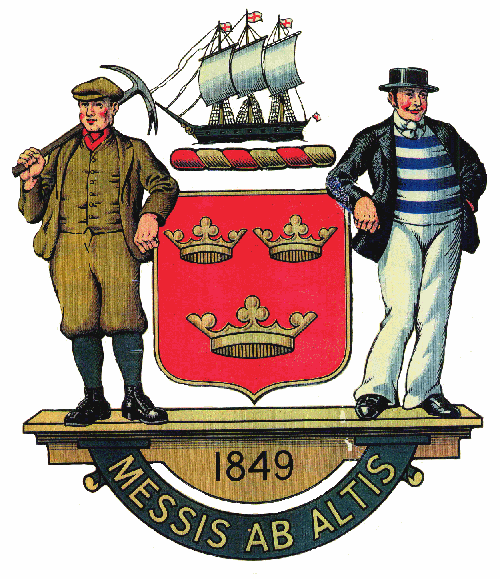
Tynemouth’s Three Kings (NZ374695)


Above is the coat of arms adopted by the Borough of Tynemouth upon its formation in 1849. The various bits and pieces are all pretty self-explanatory (the motto means something like ‘harvest of the deep’ – coal and fish, get it?). But what exactly do the three crowns mean?

Well, the shield which lies at the centre of the emblem was adopted due to its being that of the Prior of Tynemouth. And the story goes that the three crowns represent the three kings buried within the priory’s walls, namely Oswin, Osred and Malcolm.

The earliest of these, King Oswin, was the ruler of the ancient kingdom of Deira, that portion of Northumbria which lay between the Tees and the Humber. The northern bit, Bernicia, was at the time ruled by another individual. In 651, however, that other individual, one King Oswy, attacked the southern kingdom, sending Oswin first into retreat, then into surrender. Sending his troops home to save their lives, he then gave himself up to the enemy (or was betrayed – sources vary), was murdered by them, and interred at Tynemouth. He was later elevated to sainthood.

King Osred II became ruler of a united Northumbria in c.788-89, but soon fell himself in 790 to the previously deposed Aethelred. Fleeing into exile, he returned for another crack at the top job in 792, but was slain – probably by Aethelred’s men – before he’d had a chance to get himself organised. His murderers at least had the decency to have him buried at Tynemouth Priory.

King Malcolm III of Scotland died doing what he did best; raiding Northumbria. He was forever at it, and eventually paid with it with his life when he was defeated and slain at the Battle of Alnwick in 1093. His remains were interred at Tynemouth – though they were later reburied next to those of his wife, Margaret, at Dunfermline Abbey in the thirteenth century.

If you’d like to know more about the crest, see www.tynelives.org.uk/northsh/page2.htm