Showing posts with label Society of Friends. Show all posts

Tuesday, 31 October 2017

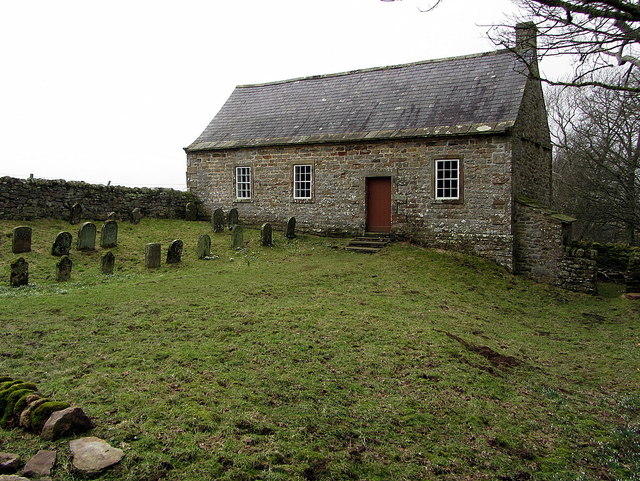
Coanwood Friends’ Meeting House (NY709589)


© Copyright Andrew Curtis and licensed for 

Quaker meeting houses are thin on the ground here in the North-East, but the one to be found at a remote spot a couple of miles east of Coanwood, Northumberland, is really rather special. For it is one of the best examples of its kind anywhere of a Society of Friends’ meeting house which has remained unaltered, internally, since its 18th century construction.

As a general rule these sorts of places were almost all remodelled in the Victorian era, but not so that at Coanwood – its remoteness no doubt helping it out in this respect. It was built in 1760 under the directions of Cuthbert Wigham, a local landowner and long-time Quaker, who had previously held meetings in his own house. Externally, the building is of sturdy stone construction, with a roof of Welsh slate – though it is thought this may have originally been heather thatched. Inside, however, little has changed in over two-and-a-half centuries.

© Copyright Mike Quinn and licensed for 

Within its robust outer shell can be found the simplest of layouts. Plain, open-backed pews face onto a raised area at the front where Elders’ benches are situated facing out over the congregation. At the rear is a movable screen designed to create a second room if required (which is heated by a small fireplace) and the whole of the interior is stone-flagged. Outside there is a small graveyard with the characteristically small, rounded headstones of the Quaker type – including that of Cuthbert Wigham, the house’s founder.

The meeting house ceased operating as a Quaker chapel in 1960, but can usually be found open to the passing public.


Tuesday, 3 July 2012

Norton’s Quakers (NZ446221)


© Copyright Carol Rose and licensed for reuse under this Creative Commons Licence

The first Quaker Meeting House proper to be built in the settlement of Norton was on the site of the current affair in the year 1671. Much altered over the years, the present structure dates from 1903 when it was rebuilt in the style of the original building.

What is remarkable, though, is how the religious body itself has managed to survive at all. Whilst some sources refer to the town’s ‘comparatively peaceful history’, the Quakers have suffered anything but a quiet existence there. Born around the time of the English Civil War, the Quaker movement made enemies of both Roundhead and Royalist alike – though the former tolerated them due to Quaker sympathies among their foot soldiers.

On the Restoration in 1660, there was a severe clamp-down on the activities of the ‘obstinate men and women’ of the parish ‘who would not let down their conventicles’. King Charles II sent a party north to root out the Quakers – one Simon Townsend having his house taken (the site of the alleged activities of the dissenters). Townsend and several others were severely punished, with the period of oppression in and around the town continuing deep into the 1660s.

The record books are peppered with cases brought against the peace-loving ‘Society of Friends’ groups of this period. At the very height of the oppression, the Norton group built their first ‘official’ Meeting House on the village green in 1671. Massive fines, transportation and the like continued for those openly flouting the obligation to attend ‘national services’ in favour of their own religious gatherings, but the Quakers hung on until the ‘freer’ days following Charles II’s death in 1685. Though, in fact, an Act was passed against them as late as 1687 barring them from entry into many professions, they laid low thereafter, concentrating on social and industrial endeavours to stunning effect through the Industrial Revolution and beyond.

More information here.


Tuesday, 29 May 2012

Teesside’s Sailing Coaches (NZ452183)


During 1845-6, ex-sailor, Joseph Taylor, struck upon the idea of using sails as a means of propulsion for railway carriages. 

Taylor ran a provisions shop in Middlesbrough near to the town’s first railway station.  In the absence of a Sunday rail service, he used to harness a horse to a railway carriage and haul his family to their place of worship – the Society of Friends Chapel – down the line to South Stockton (the northern end of the modern-day Thornaby), a distance of four miles. 

However, when the climatic conditions allowed, he was seen to dispose of the horse and affix a mast and lug sail to the carriage and glide gracefully into South Stockton at a brisk eight knots an hour.

[adapted from an article which appeared in The Monthly Chronicle of North-Country Lore & Legend of August 1891]


Remember, if you'd like to submit a short article for the 'North-East History Tour' then see the link at the top of the page. Anyone can do it!